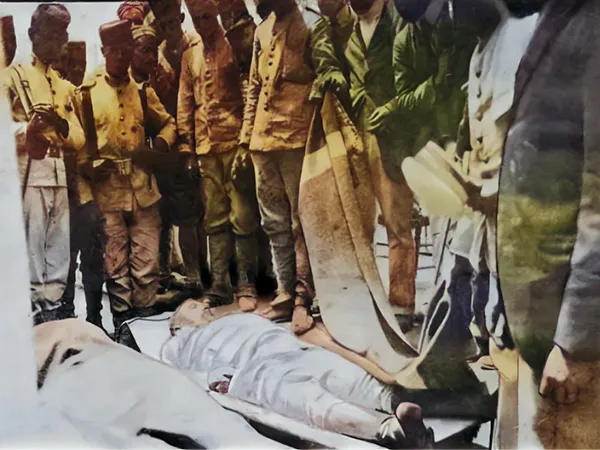
A major figure of the anti-colonialist struggle, a national hero and a legend in Indonesia, Peto Syarif is one of the most famous revolutionaries in Southeast Asia.
Also known as Muhammad Syahab, Peto Syarif studied religion and war tactics at the same time. After launching the movement for the purification of Islamic laws in Indonesia, he dedicates his life to the fight against the Dutch colonists.
While several literary works on his life exist, many omit his Moroccan origins.
Peto Syarif was first known as an imam under the name of Tuanku Imam Bonjol. Born in 1772 in Bonjol, in the west of the island of Sumatra, he is the descendant of a Moroccan family in Indonesia, the Bayanuddin family.
A rigorist childhood.

Muhammad Syahab grew up in a household where Islam is very important, and will therefore receive a religious education from his childhood onward. Besides learning to read the Quran and Islamic laws, he also learns the knowledge of metallurgy, of mining, of Silat (an Indonesian martial art) and other skills that a typical young “Minang” (the name of the ethnic group living in Sumatra) must possess.
After completing his 8 years of Islamic studies, Muhammad Syahab received the title of Peto Syarif. Peto Syarif gradually decides to contribute Islamic teachings to the community. He was described as a man greatly appreciated for his honesty, his kindness and his piety.
However, he continues to study under other Muslim theologians and takes a great interest in politics. Thus, he studies war strategies and quickly obtains an important role in the international affairs of his country.
The birth of the Padri movement.

It is in 1807, just after a pilgrimage to Mecca, that the anti-colonial struggle of Peto Syarif begins. Inspired by the young Wahhabi movement spreading across the Arabian Peninsula, he co-founds the Padri movement with other pilgrims and decides to build a fort in order to proclaim the State of Bonjol in which a current similar to Wahhabism will be applied. The State of Bonjol will succeed in reducing the production and consumption of drugs (Opium, Tobacco…) forcibly exported by the Dutch to offset their trade balance.
Following this success, Peto Syarif sent several emissaries to regions of Indonesia in order to spread his movement. They succeeded in conducting negotiations with the leaders of local communities regarding the goals and objectives of the Padri movement: eradicating the illicit practices carried out by society and fighting Western colonization.

The influence of the Padri movement grew daily and the task of Imam Bonjol became very heavy. He faced not only the traditional chiefs, but also foreign powers, namely the Dutch who had controlled Padang since 1819. Feeling their positions threatened, the Indonesian traditionalist nobility calls upon the Dutch, who intervene in 1821 to defeat the Padri faction.
At first, the Dutch could not win militarily against the Padris, their resources being exhausted by the resistance of Diponegoro in Java. They will end up signing the Masang agreement in 1824 putting an end to the hostilities with the State of Bonjol.
The end of the Padri War.
The Padri War will have lasted nearly 16 years, stretching from 1821 to 1837. First of all, the Dutch colonial forces attempt to control the West of Sumatra, the colonial government signed a treaty with the traditionalist nobility and sent troops into the hills of Minangkabau, initiating grueling battles against the partisans of the Padri movement.
It is in 1836 that the battle of the Great Fort of Bonjol takes place, during which hundreds of Dutch soldiers bombarded the defenses of the Padri and managed to infiltrate the interior of the fort. That said, with determination, the Padris will succeed in defeating the opposing camp and expelling the Dutch from the fort.
Through a ruse of negotiation, the resistance of Imam Bonjol came to an end after his capture and exile by the Dutch colonial army in October 1837. He dies on November 6, 1864, at the age of 92 and is buried in Sulawesi.
The site of his tomb is marked by a house in Minangkabau (West Sumatra). Tuanku Imam Bonjol has been named a national hero of Indonesia since November 6, 1973. The name of Tuanku Imam Bonjol is also present in public spaces (streets, stadiums…) and even appears on the 5,000 Rp banknotes issued by Bank of Indonesia on November 6, 2001.