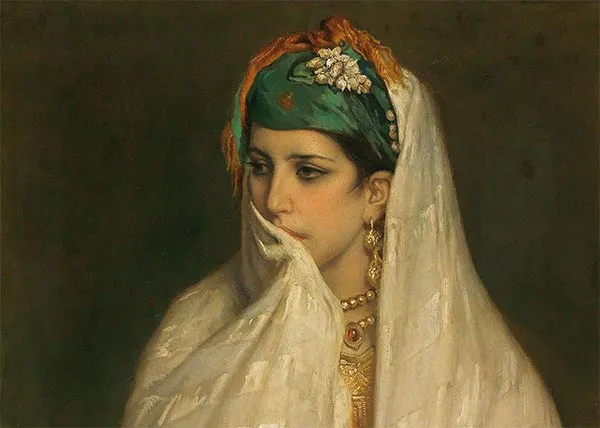
Zaynab an-Nafzawiyyah, born in Aghmat in 1039, in Morocco’s High Atlas, was a Berber queen who had great influence over the Almoravid dynasty; she was queen of Marrakech and took control of the Maghreb, as well as part of Spain. Zaynab was admired as much for her beauty as for her intelligence and her ability to rise to power. Her first husband was Luqut al-Maghraw, an emir of Aghmat, who later died in battle and whose riches and lands Zaynab both inherited and controlled. Her second husband was Yusuf ibn Ali, chief of the Wurika and Aylana Berber tribes, though according to Ibn Khaldun she may instead have been his concubine. Ibn Ali, displeased by her audacity, soon repudiates her.
She always received many marriage proposals in the region from tribal chiefs, but she always refused, for she had the ambition of marrying a man who would rule an entire country.
She thus went on to marry Abu Bakr ibn-Umar, king and founder of the Almoravid dynasty as well as of the city of Marrakech; it is said he showered her with wealth and power. Like the previous ones, this union does not last. Abu Bakr is called upon to subdue a revolt within the Sahara desert. Considering that his wife cannot follow him, he leaves her and advises her to marry his cousin Youssef ben Tachfine as-Sanhaji, to whom he entrusts command in his absence.

She gave him two children, Ali and Tamima Ben Youssef ibn Tachfine. Ibn Tachfine was able to conquer the Maghreb thanks to her counsel and her expertise in negotiations. Zaynab Nefzaouia draws up the plans of the city of Marrakech while awaiting the return of her husband, away at war. Upon his return, Ibn Tachfine has the city built in accordance with the plans she created. She was nicknamed "the magician" for this, and many people believed that she communicated with the jinn and that she had supernatural powers. She passes away around 11 years after her husband, but the year of her death is disputed, and it is presumed that she died in 1075 or later.
Her influence was felt in the mores of Almoravid Morocco, having allowed royal women to take part in politics and education. She also organized classes for noblewomen with Hafsa bint Al Hajj, one of the most celebrated poets of medieval Arabic literature. Zaynab will also employ two women physicians at the palace, something until then uncommon. Princess Fannu of the same dynasty will in turn take an active part in defending the capital from a fortress during the fall of the Almoravids in 1147.