On 6 February 1860, the city of Tetouan will be taken by the army of General O’Donnell. This victory will be celebrated in Madrid, where one will give to this war the name of “guerra de Africa,” and where the press will tell it as a crusade regained.
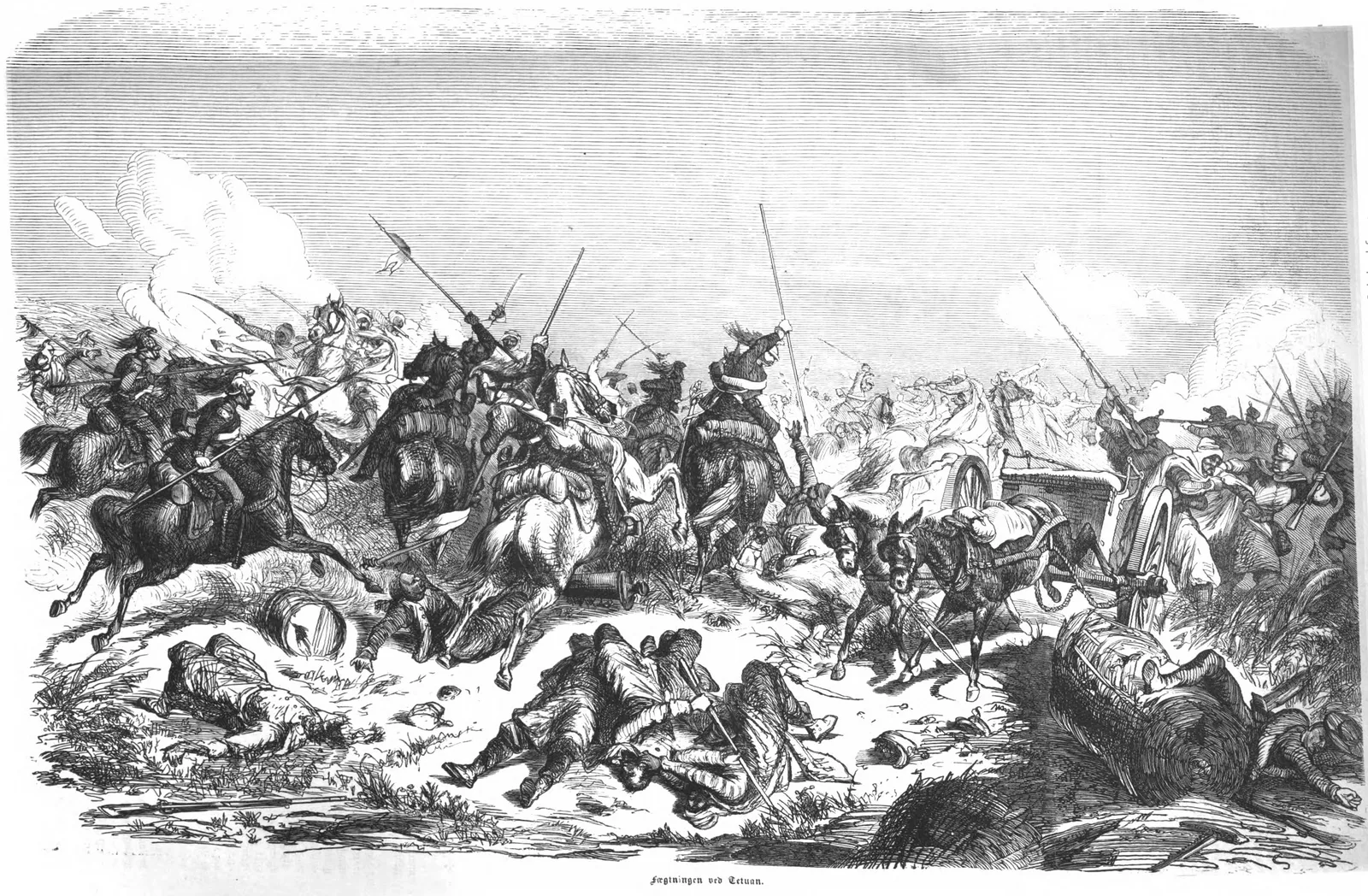
A young painter, Maria Fortuny, will be sent by the Deputation of Barcelona to paint this victory on a monumental canvas, which he will leave unfinished. The campaign, for its part, will have cost Spain some four thousand dead, of whom nearly three thousand will be due to cholera.
The peace will be signed at Wad-Ras on 26 April 1860, by a treaty that will impose on Morocco an indemnity of four hundred million reales. This sum equals twenty million duros, that is one hundred million pesetas in the currency that will come later.
The Cherifian treasury will not be able to pay this indemnity, and it will have to borrow in London in 1861, giving its customs in pledge. European agents will then be installed in the Moroccan ports to count the receipts of the customs, of which half will serve to repay Spain. The tutelages that will follow will thus be born of this debt of Tetouan.
Spain was arriving on known ground, since Melilla was occupied since 1497, and Ceuta (a Portuguese conquest become Spanish by the Treaty of Lisbon of 1668) for two centuries. To it were added the islets of the coast, the Penon de Velez, Alhucemas, then the Chafarinas, seized in January 1848 a few days before the arrival of a French column departed from Oran. The Moroccan coast was already the object of a Franco-Spanish competition, and the Makhzen was its stake.
This article sets course for the least known side of the colonization of Morocco, the Spanish side. One hundred sixteen years separate the fall of Tetouan from the departure of the last Spanish soldier from El Aaiun, in February 1976.
Between these two dates, Spain will negotiate a partition in secret and will hold its protectorate in sublease, before being humiliated by a republic born in the mountain and using arms that the conventions of the epoch forbade. Next will come a decolonization in four unequal acts (1956, 1958, 1969, 1975) and a memory which, a century later, remains to be settled.
We will see also what this adventure did to Spain herself, of which the army, formed in the Rif, will rise in 1936 against the Spanish Republic.
The partition
Two documents, one same day
On 3 October 1904, France and Spain sign in Paris a solemn declaration, where the two powers say they are “firmly attached to the integrity of the Moroccan Empire under the sovereignty of the Sultan.”
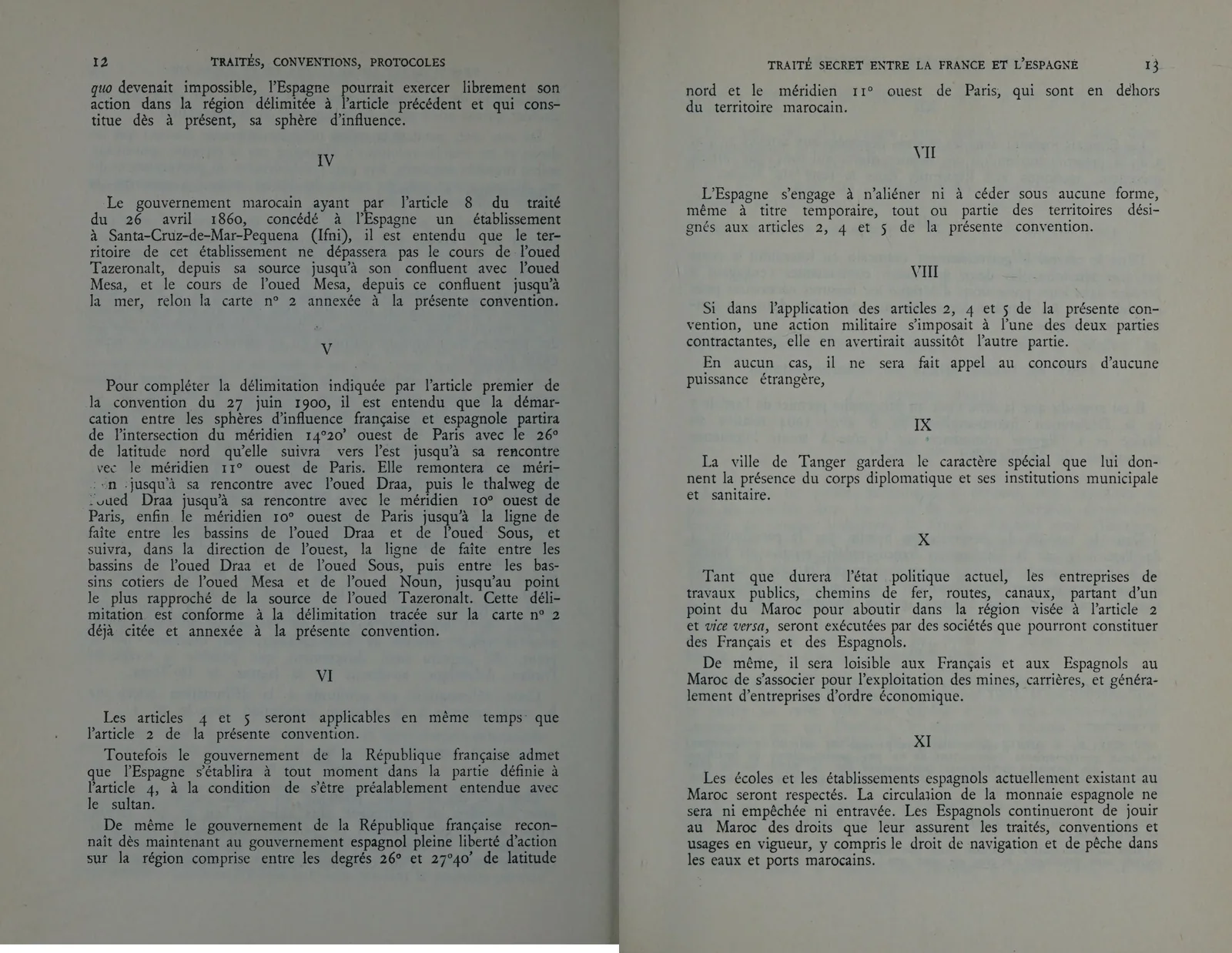
The same day and in the same office, the signatories of the declaration also initial a secret convention of sixteen articles, which cuts this empire into zones of influence from the mouth of the Moulouya up to the Atlantic. Article III even foresees the dismemberment. Should “the political condition of Morocco and the Cherifian government no longer be able to subsist,” Spain could freely “exercise its action” in its sphere. The two texts signed that day thus say the contrary of each other.
An article of this secret convention deserves that one stops on it, for it carries in germ a dispute that will only break out seventy-one years later:
“The Government of the French Republic recognizes henceforth to the Spanish Government full liberty of action over the region lying between degrees 26° and 27°40’ of north latitude and the meridian 11° west of Paris, which are outside the territory of Morocco.”
— Secret Franco-Spanish convention, article VI, 3 October 1904 (translated from the French)
Slipped into a text which was to remain secret, the formula “outside the territory of Morocco” founds the legal distinction between the protectorate (which Spain will have to return) and the “colony” of the Sahara (which she will claim to keep). It is in the secrecy of a Parisian office, in 1904, that the Saharan dispute of 1975 takes its source.
Algeciras, where the fiction becomes machinery
It was still necessary to give the affair a public facade, and this will be the work of the famous conference of Algeciras, gathered in January 1906 following the theatrical stroke of Tangier. Wilhelm II had landed there in March 1905 in order to pose as protector of the Moroccan independence, to the great displeasure of Paris.
On 7 April 1906, the General Act will be signed. Its preamble will proclaim “the sovereignty and independence of His Majesty the Sultan” and “the integrity of his States,” but its articles will organize the tutelage. The police of the eight ports open to commerce will be entrusted to French and Spanish instructors (Spanish at Tetouan and Larache, French at Rabat, mixed at Tangier and Casablanca). Six years later, the zones of 1912 will follow this same partition.
The State Bank of Morocco, which will receive the monopoly of issue for forty years, will be placed under the tutelage of the central banks of Europe, and the independence of Morocco will thus be guaranteed by twelve powers. There will also be the regime of the consular proteges, locked as early as the Madrid convention of 1880, which will withdraw from the tax and from the justice of the Sultan a growing clientele of Moroccans. The Makhzen will therefore be prevented from taxing as from borrowing.
A protectorate in sublease
On 30 March 1912, in Fes, Sultan Moulay Abdelhafid will sign the protectorate treaty with France. A Resident-General, “depositary of all the powers of the Republic in Morocco,” will approve and promulgate all the dahirs. His Cherifian Majesty, for his part, “forbids himself to contract in the future, directly or indirectly, any public or private loan” without French authorization. A few months later, the bloody riots of Fes will follow the signature (we told these days elsewhere), and Abdelhafid will abdicate before the end of summer.
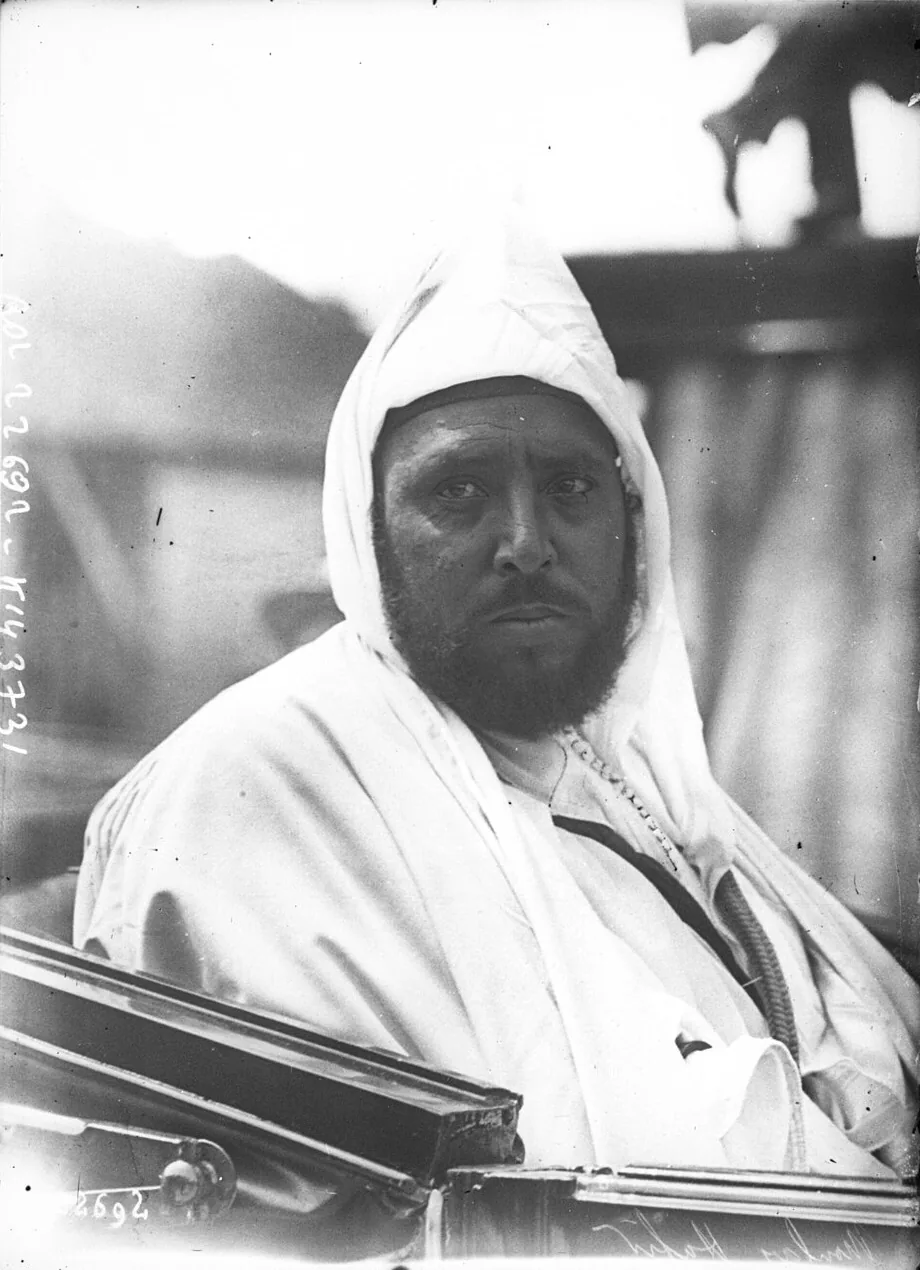
As for Spain, she does not even treat with the Sultan, since her zone is conceded to her by France in the Franco-Spanish convention of 27 November 1912, Madrid thus holding its protectorate in sublease.
The legal architecture of this convention is moreover worth the detour, the regions of the north remaining there in theory “under the civil and religious authority of the Sultan.” They will however be administered by a khalifa residing in Tetouan, chosen by the Sultan… from a list of two names presented by Spain, revocable only with the consent of Madrid, and flanked by a Spanish High Commissioner who governs for real. The last paragraph of the first article confesses the fiction, by stipulating that the Cherifian government will not be able to be held responsible for what will happen in the Spanish zone.
The financial partition thus obeys the same logic, articles 10 and 11 obliging the Spanish zone to finance itself on its own resources and forbidding the Makhzen to contribute to it, while article 12 fixes at 7.95% of customs its share of the loan charges of Morocco.
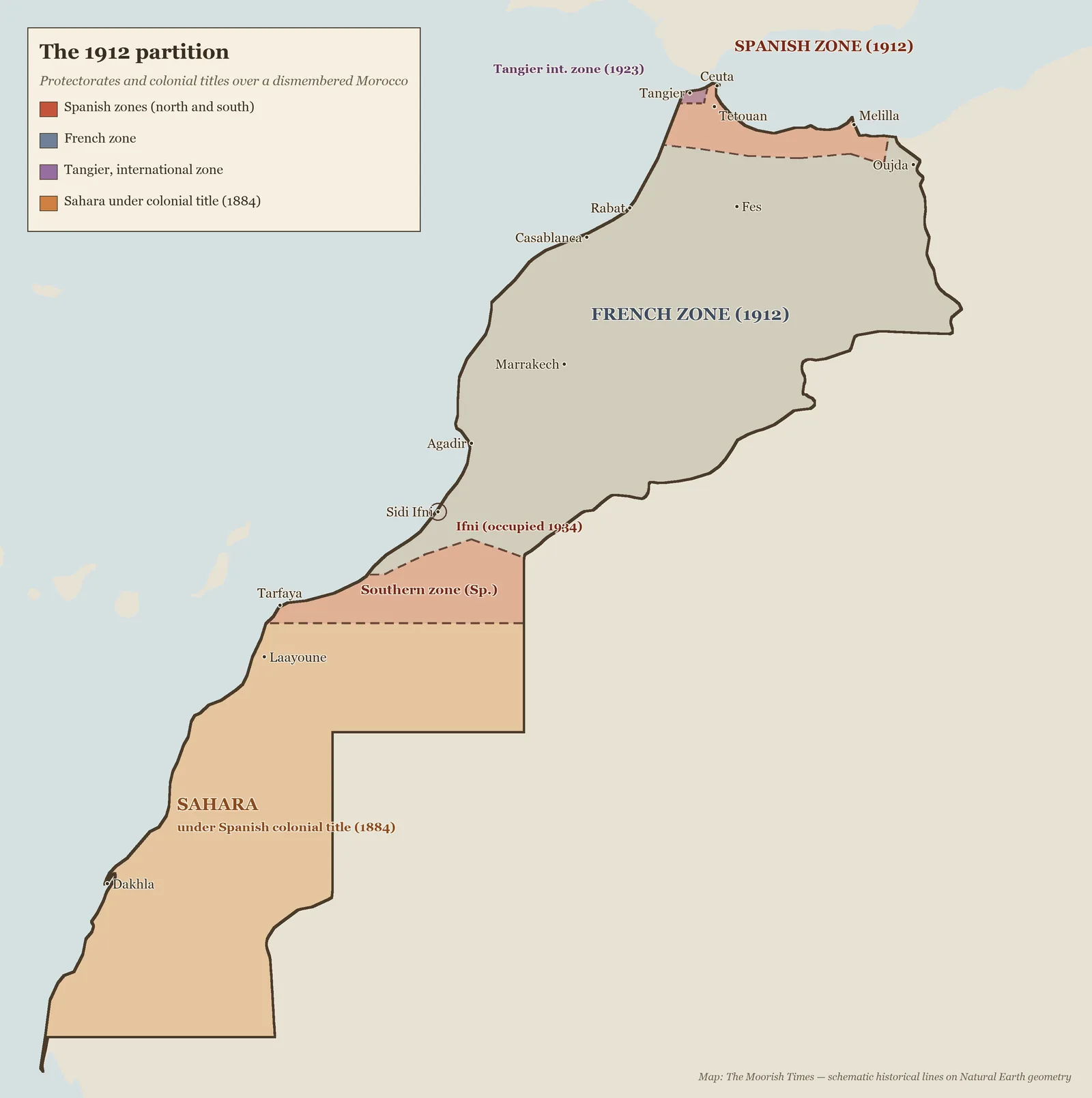
Thus, Spain receives the Rif and the Jbala, that is 21,000 square kilometers of mountains, one-seventh of arable lands and less than 8% of the customs base of the country, when France has Casablanca, the plains, Fes, the ports and soon the phosphates. Having at her disposal only mountains, a legal fiction and an army, Spain will write the history of her zone in military campaigns, and this treaty bears the first responsibility for it. Tangier, finally, is reserved, the city having to wait for 1923 to have its international statute.
The forbidden weapons
A procurement schedule
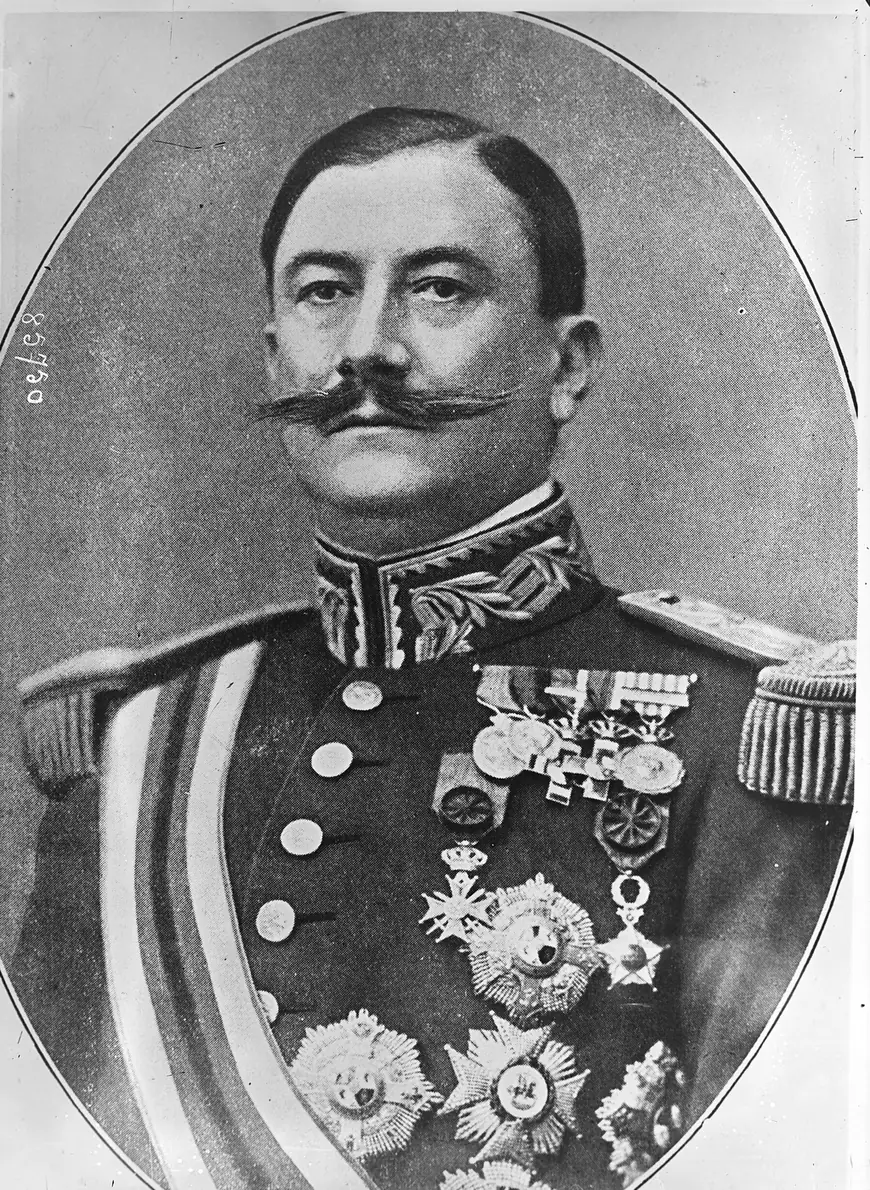
Annual falls on 22 July 1921. On 12 August, three weeks later, the High Commissioner Damaso Berenguer telegraphs to Madrid. He had always refused, he writes, to employ asphyxiating gases against these populations, but after what has just happened, he will employ them “with true relish.”
On 20 August, Spain approaches Germany. In December, she buys 50,000 liters of chloropicrin. In the spring of 1922, a shell-loading workshop functions in Melilla. In October 1922, a commission placed under the patronage of the King proposes to mount the gases on airplanes. At the end of 1923, the contract of the great factory is signed. This chronology is that of a planned procurement.
The German connection
The supplier will be Weimar Germany. Barred from chemical weapons by the Treaty of Versailles, Germany sold to Spain its surplus, its patents and its men, through the intermediary of the Stoltzenberg firm, private facade of a state agreement.
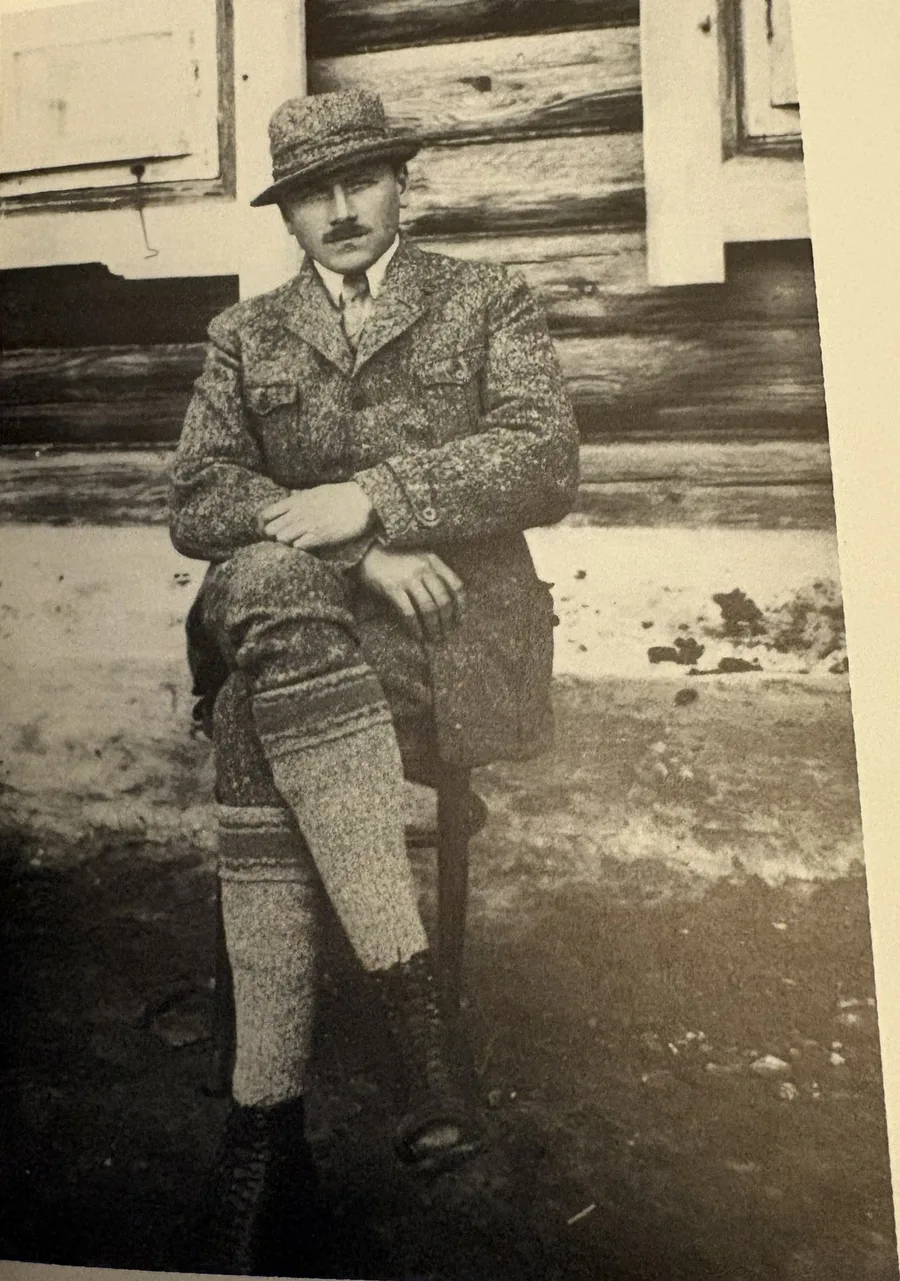
Hugo Stoltzenberg, gas chemist of the Great War, will even take the Spanish nationality to direct the factory he was building near Madrid. This factory is called the Fabrica Nacional de Productos Quimicos Alfonso XIII. The mustard gas works thus bore the name of the King, and the site, renamed La Maranosa, houses today a research institute of the Spanish Ministry of Defense.
Raining on the souks
The gases arrive by artillery from the autumn of 1921, and the mustard gas by air in the summer of 1924. Between the two, Spain perfects her chemical war, with shells reloaded at Melilla and nocturnal bombardments (the heat of the day dissipated the clouds).
The German advisers recommended aiming at the fields, the springs and the souks at the busiest hours, mustard gas contaminating precisely all that it touches. The calculation is agrarian, one poisons the harvest and the well, and the tribe surrenders because it is hungry. The German historians Rudibert Kunz and Rolf-Dieter Muller, first to document the affair in the archives, count more than ten thousand chemical containers (shells and bombs) and more than 500 metric tons of agents dumped.
France herself will supply, in the last months of the war, chemical munitions to her own front, and if their use in combat is less documented, the supply, for its part, is beyond doubt. Spain made of them a systematic and aerial use, which she directed against the civilian habitat.
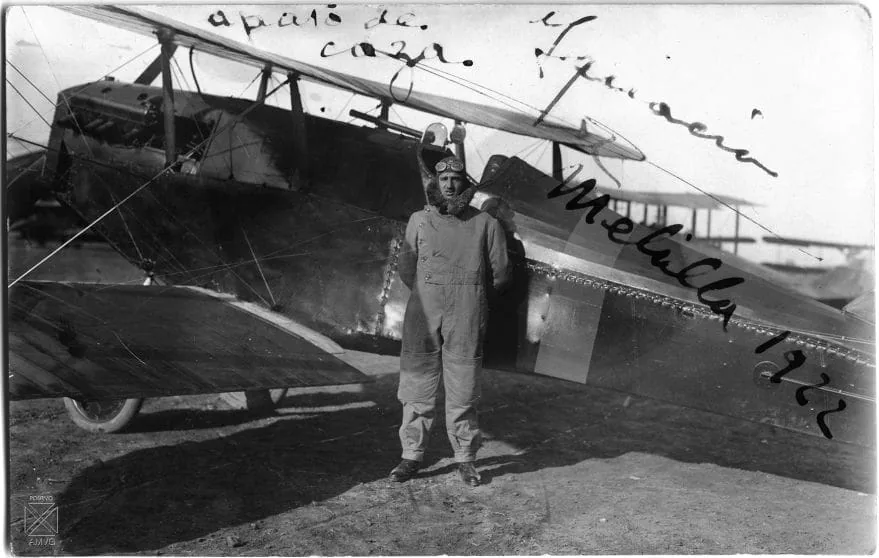
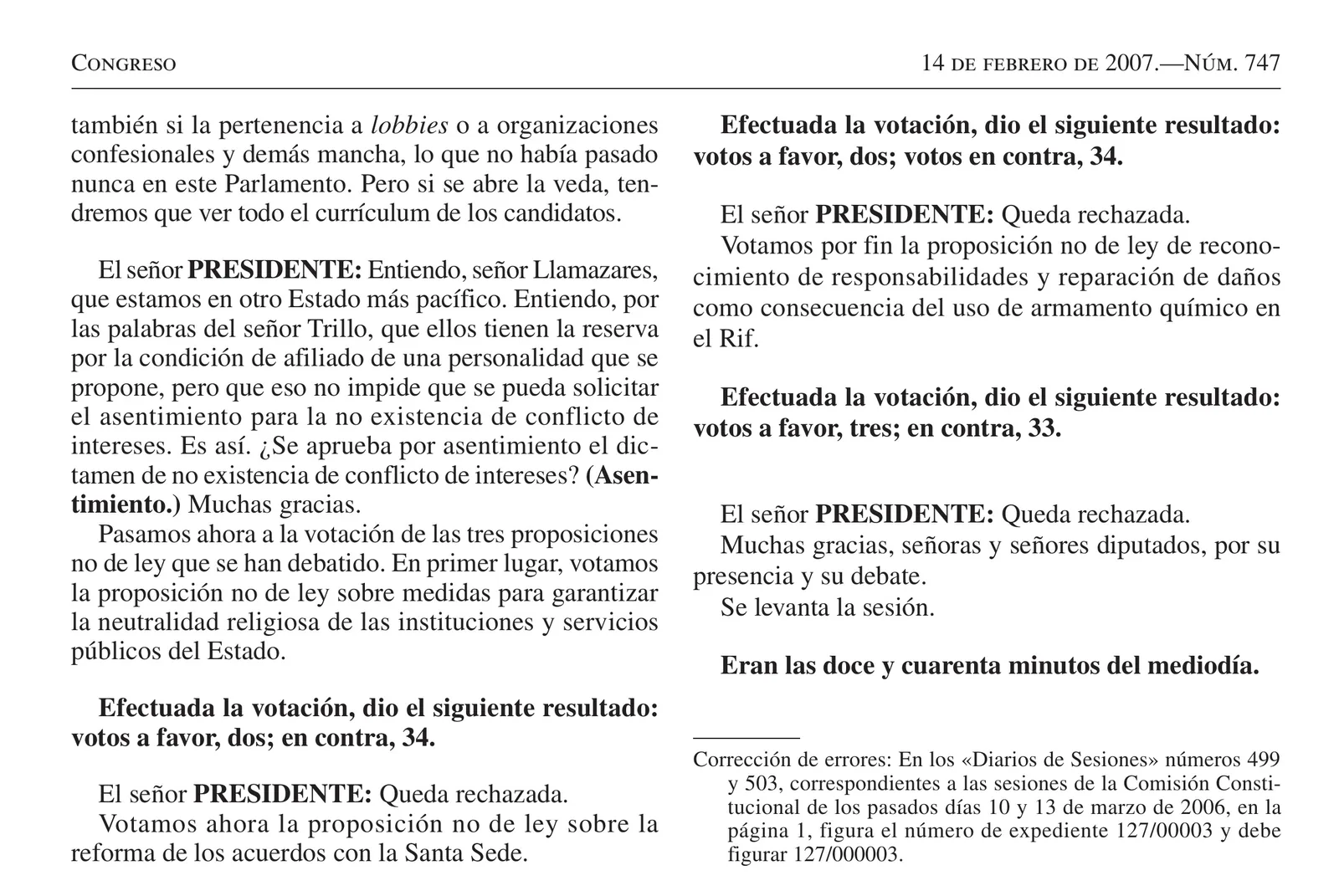
The clearest testimony comes from an aviator, Ignacio Hidalgo de Cisneros, future chief of the Spanish Republican aviation, who will recount in his memoirs the summer of 1924, and whose words were read at the Spanish Congress of Deputies in 2007:
“In those days it fell to me to carry out a truly vile piece of work, which earned me the shameful and sad privilege of being the first aviator to drop mustard gas from an airplane. It is curious how many years had to pass before I became aware of the monstrosity I was committing in gassing the Moorish villages.”
— Ignacio Hidalgo de Cisneros, Cambio de rumbo; read into the record of the Congress of Deputies, 14 February 2007 (translated from the Spanish)
As for King Alfonso XIII, the Spanish literature lends him words of extermination. These quotations circulate without archival reference, and a book published in 2026 contests their authenticity. We will thus not print them, since the telegram of Berenguer, the royal commission of 1922 and the name of the factory suffice to situate the responsibilities.
Counting what was never counted
Two things are established on the question of cancer, which haunts the Rif today. The first is that Spain gassed civilians, which the archives prove in four languages. The second is that mustard gas is carcinogenic for man, since it figures in Group 1 of the IARC, and that the Iranian veterans exposed in the 1980s develop almost twice as many cancers as the others.
One commonly affirms that “the gas of 1925 causes the cancers of 2026,” but this affirmation has not been verified. The provinces of the Rif are covered to this day by no cancer registry, and the case-control study remains to be done, just like the analysis of soils and waters.
Two figures circulate, and they do not have the same origin. The first is “Half of Morocco’s cancers” and it goes back to a hospital-corridor impression, which was given at a colloquium in 2008 without leaning on a study. The second, “80% of Rabat’s patients,” is attributed to no one.
The historian Maria Rosa de Madariaga documented this chemical war better than anyone. She judges however hazardous the idea of attributing the current cancers to this war. Now, the only regional dataset available places the province of Nador among the least affected of the Oriental, and this ranking reflects the absence of counting in the Rif.
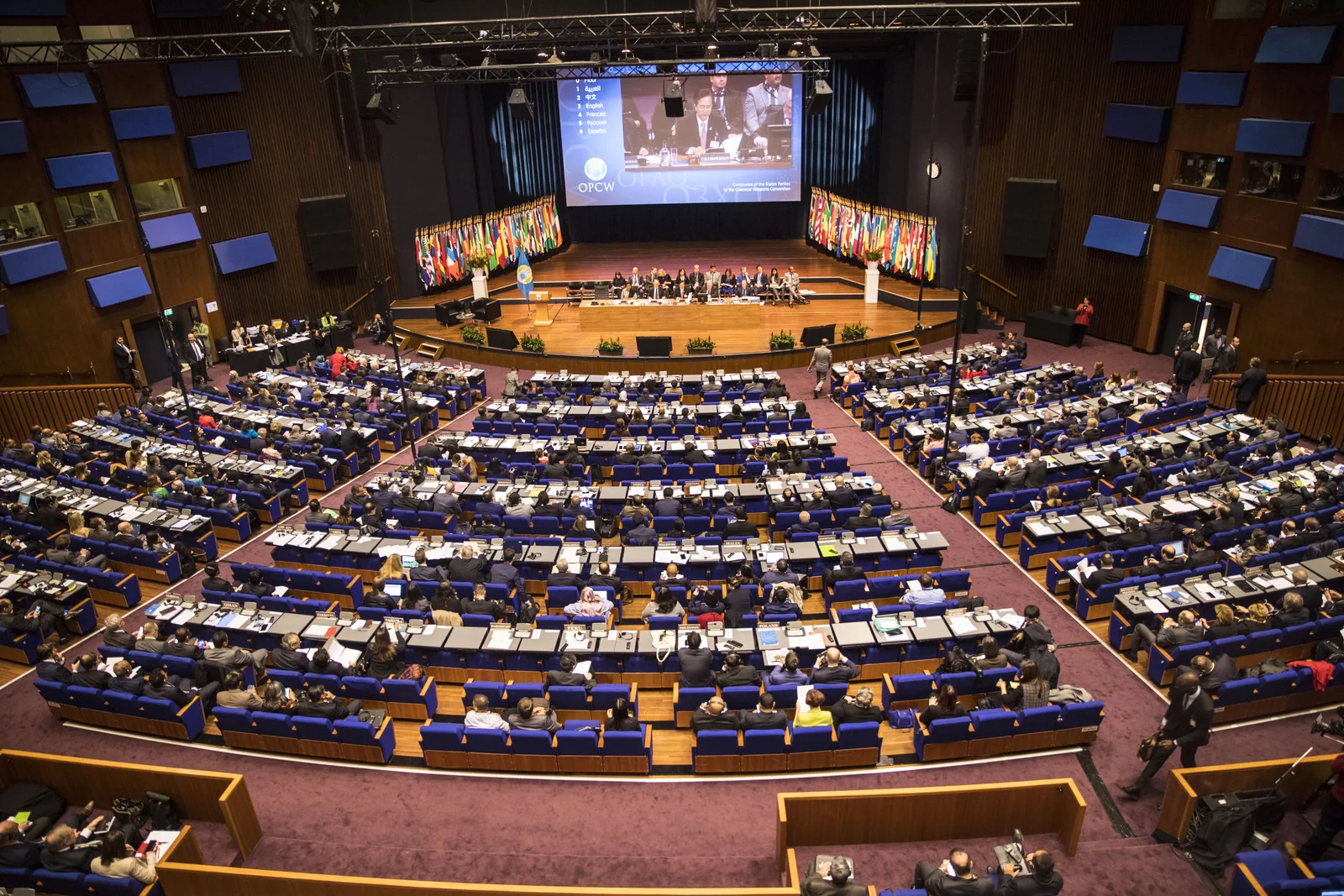
The Rifians believe themselves poisoned, and one refuses them even the measurement. The Rif Memory Association thus carried the file to The Hague in 2019, before the Organisation for the Prohibition of Chemical Weapons:
“We presented last year a petition to the Secretary General to send OPCW inspectors to the Rif… unfortunately we have received no response.”
— Abdelmajid Azzouzi, Rif Memory Association, 24th OPCW Conference of the States Parties, The Hague, November 2019
The association formulates five demands, claiming notably the recognition, the opening of the military archives, the freedom of investigation and the reparation. The fifth says a lot, since it asks to detect the contaminated zones and to study at last the long-term effects. These demands still await a beginning of answer, the association not having received the slightest letter in return.
The long twilight
The Regulares and the confiscated letters
Irony willed that the next war of Spain begin in Morocco. On 17 July 1936, it is in Melilla and Tetouan that the uprising against the Spanish Republic rises.
Franco will win his war with tens of thousands of Moroccan soldiers (the serious estimates go from seventy-five thousand to more than one hundred thousand men, of whom thousands of minors). Many were recruited in a Rif that the famine of the years 1934-35 was finishing off, ten years after the gases.
The regime will know, besides, how to play on its zone. From December 1936, Franco legalizes the nationalist party of Abdelkhalek Torres in Tetouan, by calculation, for a Moroccan nationalism tolerated in the north directly bothered the French zone. The north thus had legal parties and a press when the south had none.
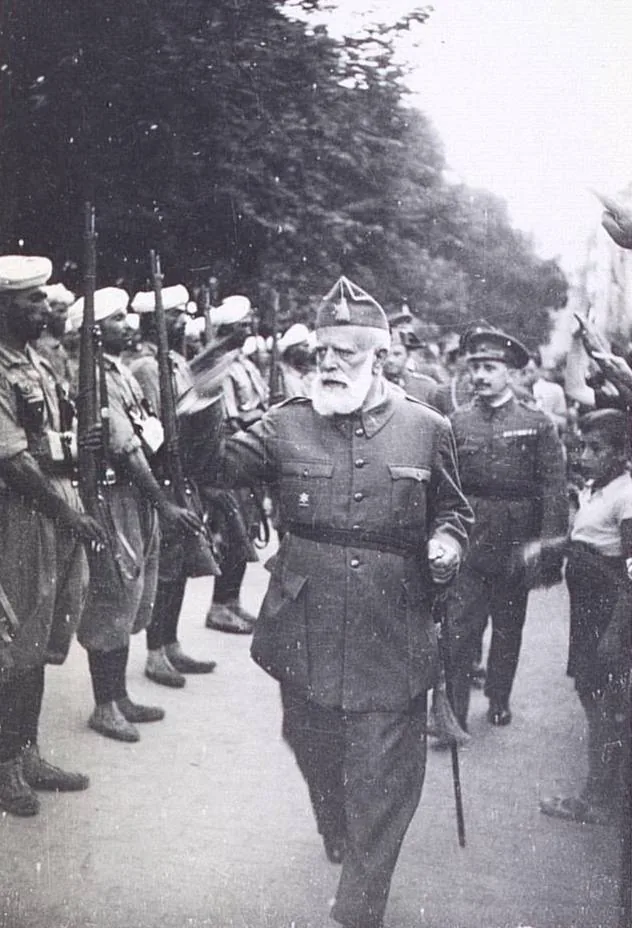
This forced encounter between the Rif and Spain left in the archives an overwhelming trace, exhumed recently by two researchers in the holdings of Alcala de Henares. It is about hundreds of love letters between Moroccan soldiers and Spanish women, which the Francoist censorship confiscated because it saw in these unions a threat to the “prestige of the race.”
“When will you come back to Spain?” writes Carmela, from Granada, in 1944, in a letter that will not be delivered, a directive of 1937 ordering to prevent these marriages “without openly banning them.”
The zone that did not follow
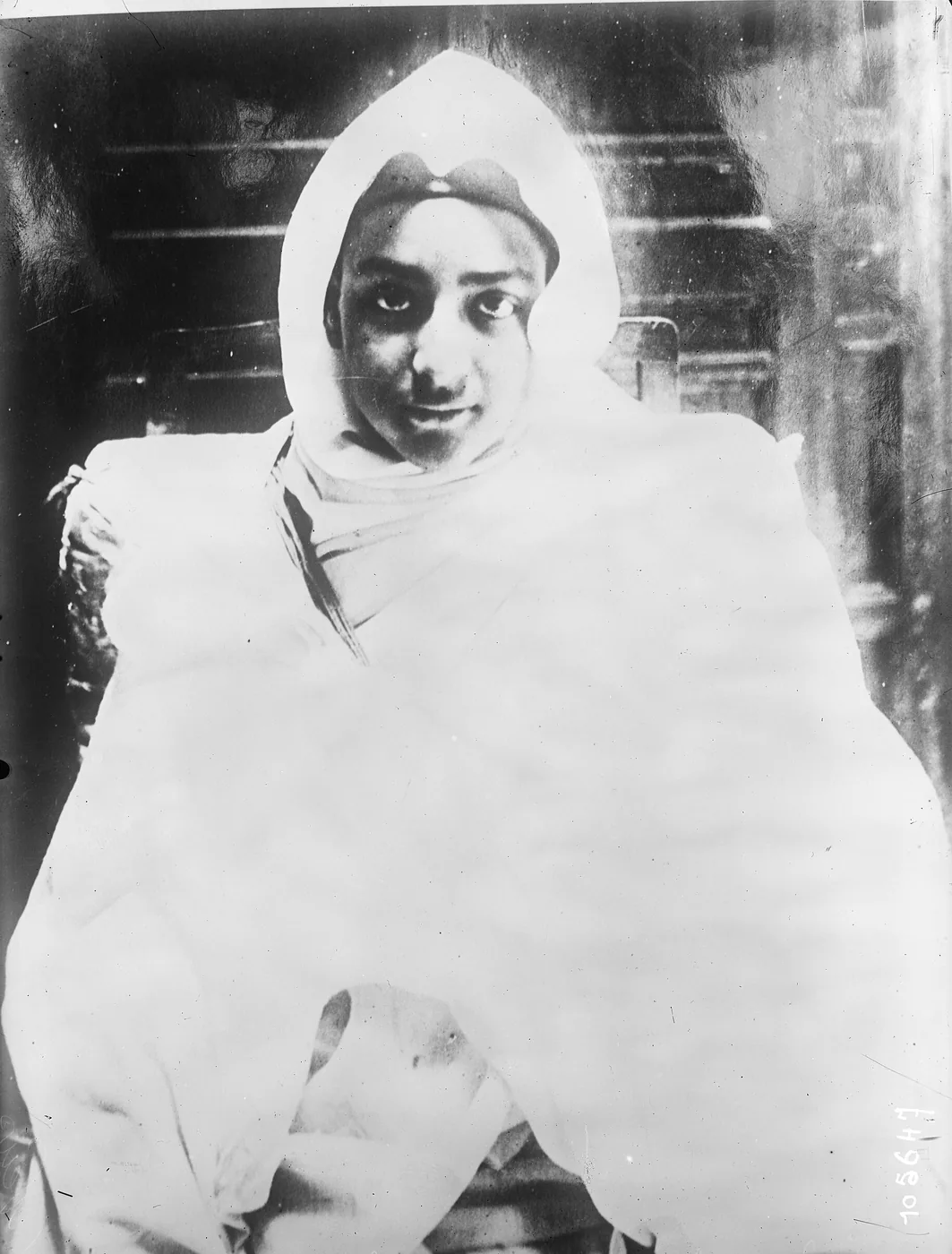
On 20 August 1953, France will depose Mohammed V and will exile him to Corsica, before sending him to Madagascar. The legal fiction of 1912 will then turn against its authors, since the Spanish zone will refuse to follow France.
Paris will install a replacement sultan, Ben Arafa. The khalifa Moulay El Hassan ben El Mehdi will refuse to recognize him, and Tetouan will become one of the lungs of Moroccan nationalism. The Spanish historiography noted that in the mosques of the zone, the Friday prayer will continue to be said in the name of Mohammed V.
Francoist Spain will let it happen, because this situation embarrasses France. She hoped however that the khalifa would enter into dissidence, which will not happen. During these years, the north will know that the kingdom has only one legitimate king, although it is cut in two zones.
Two independences and a remainder
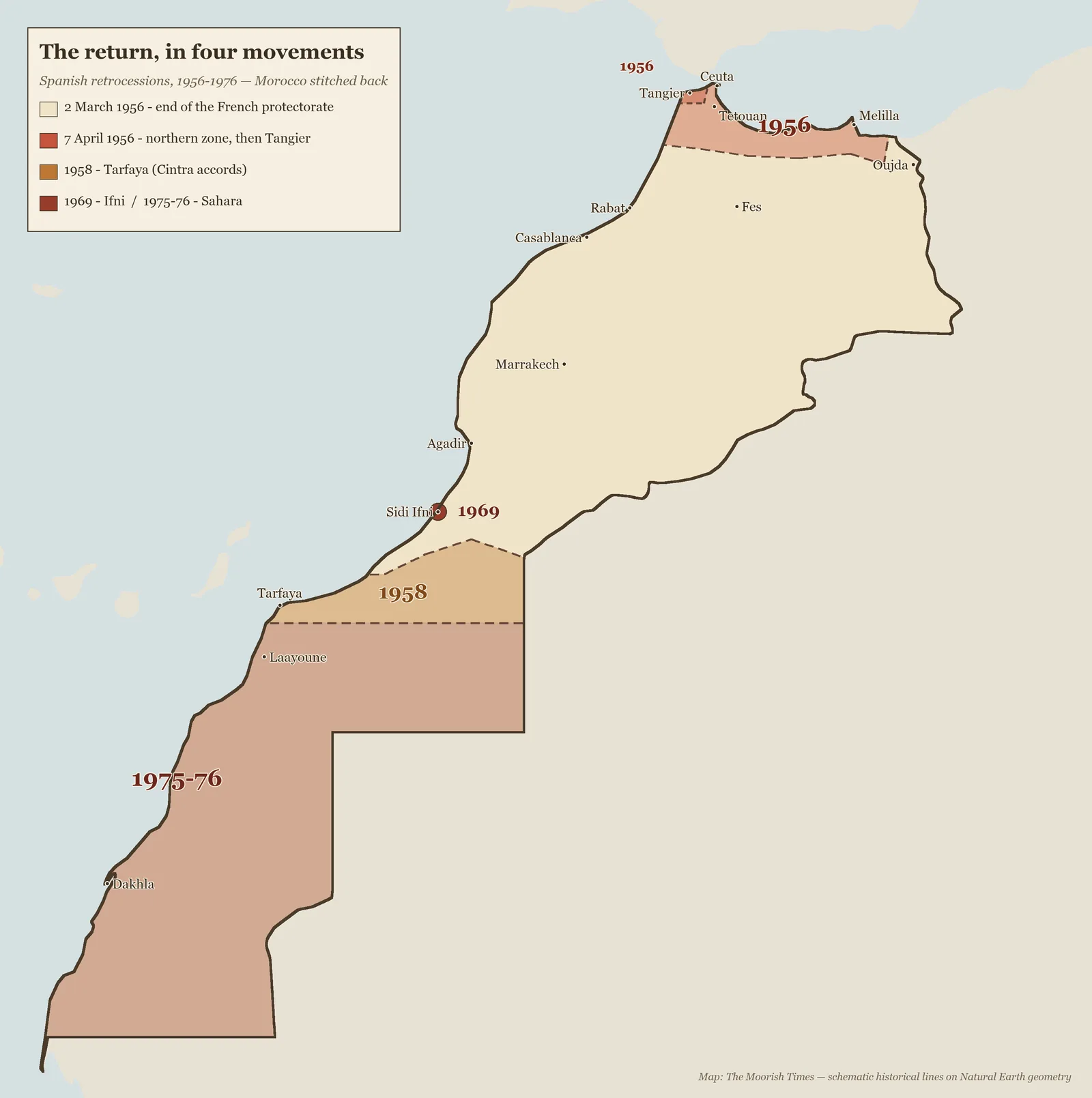
France will be the first to yield, by the declaration of 2 March 1956, which will put an end to her protectorate. Spain, for her part, will recognize on 7 April in Madrid the independence and the territorial unity of Morocco, and Rabat will remind her of this formula for seventy years. The Spanish press will congratulate itself on having made disappear from this text the word “interdependence,” which France had imposed in hers. On 29 October, Tangier will be returned to Morocco by the Fedala conference, but the legal partition of 1904 will allow Spain to keep a part of what she held.
Madrid will keep four territories, in the name of four different theories. The first will be the southern zone of the protectorate (Tarfaya), which she will logically have to restore, and the second will be Ifni, which the treaty of 1860 ceded to her. The third will be the Sahara, which she holds as a colony (“outside the territory of Morocco,” said the secret article of 1904), and the fourth will be constituted of the presidios of Ceuta and Melilla, which she proclaims Spanish cities.
The war nobody tells
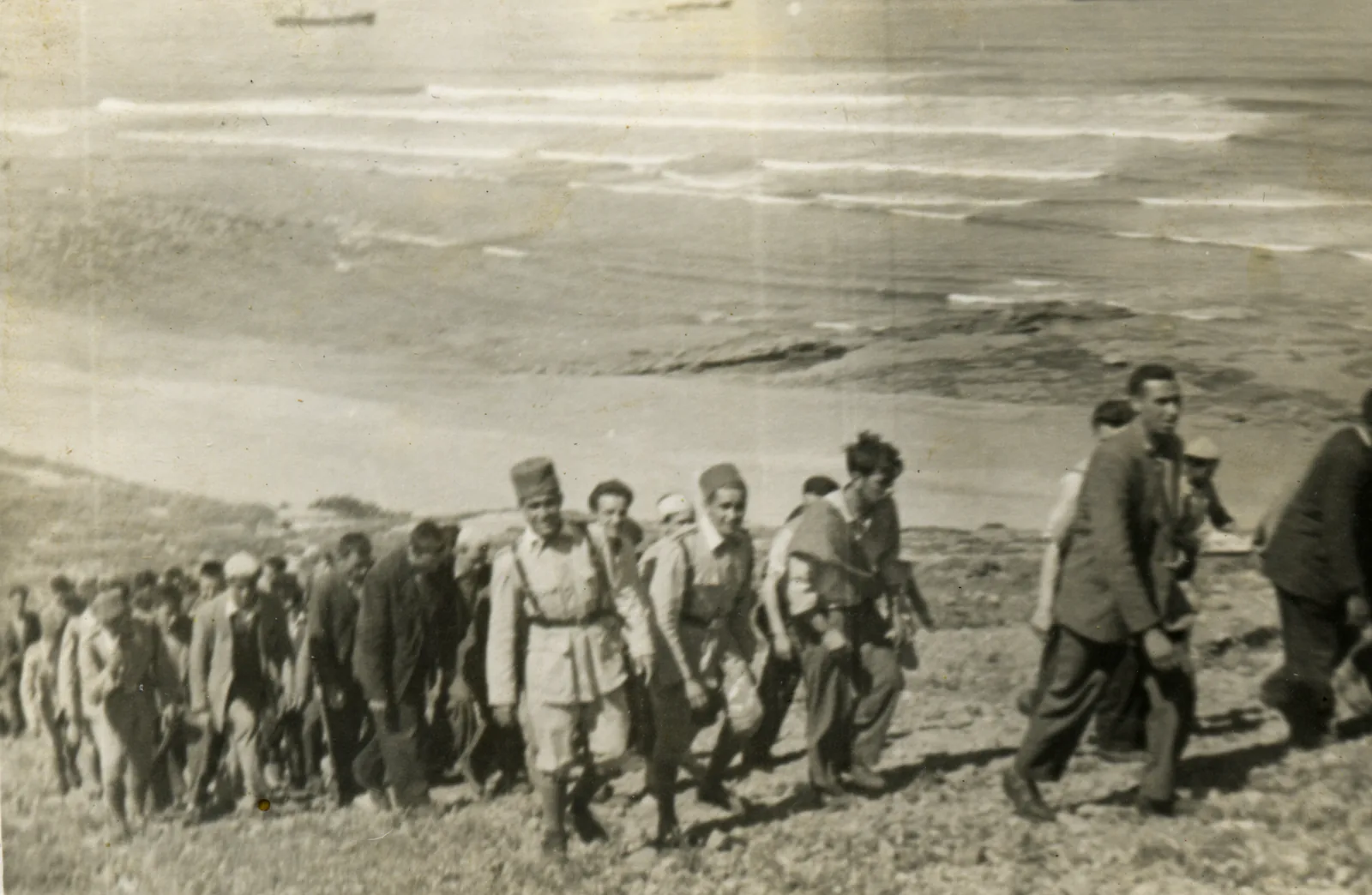
Without waiting for the jurists, the southern branch of the Moroccan Army of Liberation attacks, in the autumn of 1957, the Spanish positions of the Sahara and lays siege to Sidi Ifni. In January 1958, eighty-seven men of the Spanish Legion will be put out of action at Edchera in a single day.
The reply will come in February, and it will come as a pair, nine thousand Spanish soldiers and five thousand French leading together, under one hundred fifty aircraft, Operation Ecouvillon-Teide against the Moroccan fighters of the Sahara. Thus, two years after having recognized the independence of Morocco, the two former protecting powers make a common campaign against Moroccans, a fact that we report as such.
Diplomacy closes the parenthesis in April. By the accords known as Angra de Cintra (1 April 1958), Spain restores the Tarfaya zone, handed to Morocco at Villa Bens on 10 April, in the presence of the Crown Prince Moulay Hassan. This will be the first movement of the countdown.
The United Nations clock
The second movement plays out in New York. On 16 December 1965, the General Assembly “urgently requests” Spain to take immediately the necessary measures “for the liberation of the Territories of Ifni and Spanish Sahara from colonial domination.”
Spain complies on one file and braces itself on the other. Ifni is retroceded by the Treaty of Fez of 4 January 1969 (the Spanish flag comes down there on 30 June). The Sahara, a “province” since 1958, industrializes on the contrary, and the phosphates of Bou Craa enter into exploitation in 1973. In August 1974, Madrid announces at last a self-determination referendum. Morocco answers by bringing the question before the International Court of Justice.
16 October 1975
The opinion of the Court falls on 16 October 1975, and each will only ever quote the half of it that suits him. The text deserves better:
“The materials and information presented to the Court show the existence, at the time of Spanish colonization, of legal ties of allegiance between the Sultan of Morocco and some of the tribes living in the territory of Western Sahara. […] On the other hand, the Court’s conclusion is that the materials and information presented to it do not establish any tie of territorial sovereignty between the territory of Western Sahara and the Kingdom of Morocco or the Mauritanian entity.”
— International Court of Justice, Advisory Opinion of 16 October 1975
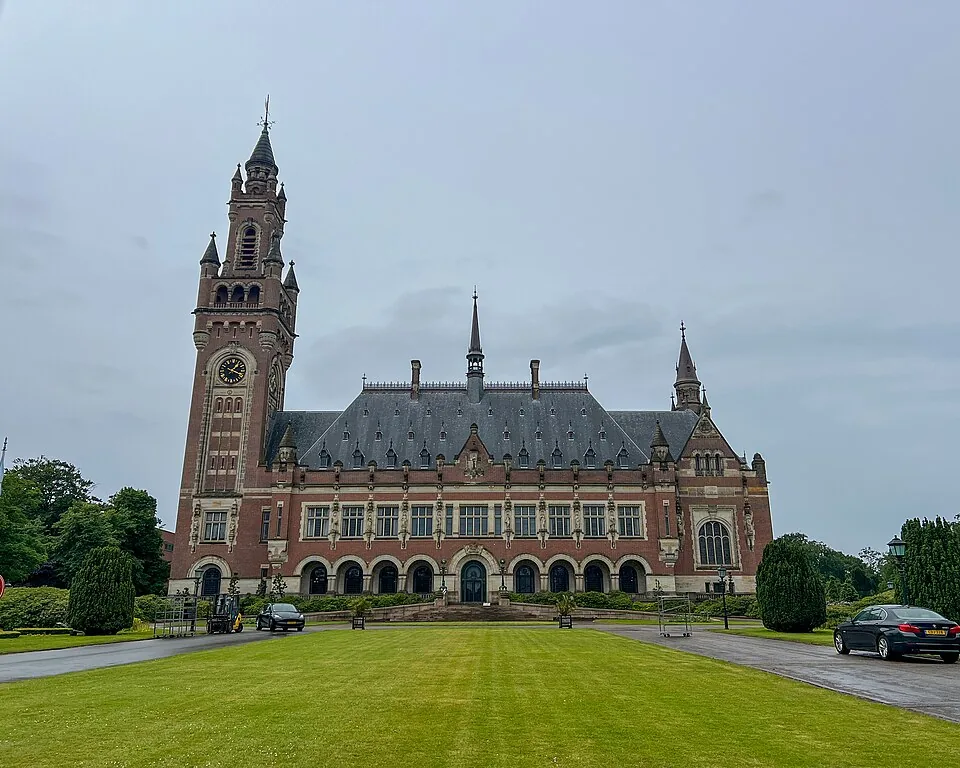
The opinion will recognize ties of allegiance (by fourteen votes to two), and it will rule out the terra nullius (by unanimity). It will not establish territorial sovereignty, and it will refer back to self-determination. The very same evening, Hassan II will announce to the Moroccan people a peaceful march toward the Sahara.
Three weeks later, on 6 November 1975, the border will be crossed at Tah by three hundred fifty thousand unarmed volunteers, who will hold in hand the Quran and the flag. This figure is official, and it corresponds to the volunteers who were selected by provincial quotas, out of more than half a million registrations. This Green March was told in another article, and only its diplomatic mechanics will be in question here.
On 9 November, the King recalls the marchers. On the 14th, in Madrid, the Spain of a dying Franco signs with Morocco and Mauritania a declaration of principles which transfers the responsibilities and powers that Spain holds over the territory “as administering Power.” The text, registered at the United Nations, transfers the administration and does not say a word about sovereignty.
Franco dies six days later. On 26 February 1976, the ambassador Jaime de Pinies writes to the Secretary-General that Spain “as of today, definitively terminates its presence in the Territory.”
One hundred sixteen years after Tetouan, the last Spanish soldier leaves the Saharan soil. Morocco reintegrates its southern provinces, and another history begins (that of the conflict maintained from Algiers), which is not the subject of this dossier.
What remains
A memory in three voices
What does Spain do with this past? On 14 February 2007, the Congress of Deputies examines in committee a proposal asking for the recognition of the chemical war of the Rif and a gesture of reparation.
The deputy who defends it recalls notably that “for the Rif, this was its Guernica,” but an elected member of the Partido Popular jokes about the possible confusion between “the Rif and the Ritz,” and the proposal is finally rejected by thirty-three votes to three, majority and opposition combined.
The session will even be entitled to its ritual counter-argument, the reminder of the bombardments of the Rif by independent Morocco itself in 1958-1959, which one brandishes at each Spanish debate, and each time without primary source. Since then, in 2018 as in 2022, the situation has not moved an inch.
The Spanish conscript of Annual, that peasant of Extremadura gone to die for lack of being able to pay the two thousand pesetas that exempted from Africa, was, he too, a victim of the system. The Spanish left besides recognizes it willingly, keeping silent on the other hand about the rest.
On the Spanish side, civil society sometimes moves faster than the state. In the spring of 2026, one hundred years almost day for day after the surrender of Targuist, an Andalusian association for the defense of human rights launched a campaign for the recognition, the opening of the archives and solemn apologies. The same week, the Congress hosted the screening of a documentary celebrating the centenary of the Alhucemas landing.
The archives ajar
However, two evolutions were playing in favor of memory, the first being legislative. In July 2025, the Spanish government approved a bill on classified information which would replace the Francoist law of official secrets of 1968 and would declassify automatically the documents of more than forty-five years. The Madrid press at once listed what these boxes contain, notably the file of 1975 on the hasty withdrawal from the Sahara.
Bogged down more than a year in committee, the text will finally not reach the vote, having lapsed on 6 October 2026 following the dissolution of the Cortes pronounced that day, which sent the Spaniards back to the polls for 29 November. The archives thus remain closed, and it will fall to the next Parliament to take everything up again.
The second evolution, diplomatic this one, is for its part secured. On 14 March 2022, the head of the Spanish government wrote to Mohammed VI that, for the territory that Spain had left in 1976, the Moroccan autonomy plan constituted “the most serious, realistic and credible basis.” Ceuta, Melilla and the islets remain Spanish, last legacy of the five centuries of presidios, and we have devoted to Sebta an entire article, this file remaining open.
Let us return finally to the Rif which, a century after the bombardments, still awaits its cancer registry, its soil analyses and its epidemiological study, while Morocco reconstituted its territory piece by piece, from Tetouan to Tarfaya and from Ifni to El Aaiun. We have only to hope that the Rif obtains in its turn the measurement that is still refused to it.
- Franco-Spanish Declaration and secret convention of 3 October 1904; General Act of Algeciras (7 April 1906); Treaty of Fes (30 March 1912); Franco-Spanish Convention of 27 November 1912 — full texts, Digithèque MJP, Université de Perpignan.
- Tratado de paz y amistad (Wad-Ras, 26 April 1860) — Colección de los Tratados, official Spanish edition.
- Sebastian Balfour, Deadly Embrace: Morocco and the Road to the Spanish Civil War, Oxford University Press, 2002.
- C.R. Pennell, A Country with a Government and a Flag: The Rif War in Morocco, 1921-1926, MENAS Press, 1986.
- David S. Woolman, Rebels in the Rif: Abd el Krim and the Rif Rebellion, Stanford University Press, 1968.
- María Rosa de Madariaga, En el Barranco del Lobo. Las guerras de Marruecos, Alianza, 2005.
- María Rosa de Madariaga, Abd el-Krim el Jatabi. La lucha por la independencia, Alianza, 2009.
- Rudibert Kunz & Rolf-Dieter Müller, Giftgas gegen Abd el Krim. Deutschland, Spanien und der Gaskrieg in Spanisch-Marokko 1922-1927, Rombach, 1990.
- Germain Ayache, Les origines de la guerre du Rif, Publications de la Sorbonne / SMER, 1981.
- André Tardieu, La conférence d’Algésiras, Félix Alcan, 1908.
- Expediente Picasso — Archivo Histórico Nacional (PARES), FC-Tribunal Supremo, exp. 50.
- ABC (Madrid), editions of 24-28 July 1921, 26 October 1921, 30 January 1923, 14 September 1923, 10-11 September 1925, 8 April 1956, 7 November 1975 — Hemeroteca ABC.
- Blanco y Negro, 14 August 1921 — Hemeroteca ABC.
- TIME, “Peripatetics: After 21 Years”, 9 June 1947.
- Boletín Oficial de las Cortes Generales, Serie D nº 255, 7 September 2005 (ERC motion); Diario de Sesiones del Congreso, Comisiones nº 747, 14 February 2007.
- Spanish-Moroccan joint declaration, Madrid, 7 April 1956; Fedala Protocol, 29 October 1956.
- Tratado de retrocesión de Ifni, Fez, 4 January 1969 — BOE-A-1969-694.
- United Nations General Assembly resolutions 2072 (XX), 3292 (XXIX), 3458 A and B (XXX).
- International Court of Justice, Western Sahara, Advisory Opinion of 16 October 1975.
- Madrid Declaration of Principles, 14 November 1975 — United Nations Treaty Series, vol. 988, I-14450.
- Letter from Spain to the Secretary-General of the United Nations, 26 February 1976 — A/31/56–S/11997.
- Statement by the Rif Memory Association, 24th OPCW Conference of the States Parties, The Hague, November 2019.
- Arthur Asseraf, “The Spanish-Moroccan letters of forbidden love that were never received”, BBC News, December 2023.
- El País, 21 and 28 July 2025 (classified-information bill; “Lo que ocultan los papeles secretos del franquismo y la Transición”, M. González); Congreso de los Diputados, initiative 121/000067 (lapsed 6 October 2026); Real Decreto 806/2026 de disolución de las Cortes, BOE of 6 October 2026.
- José E. Martínez, “Chemical weapons in the Rif War”, Frontiers in Political Science, October 2025.
- F. Ouahbi et al., Nador oncology hospital registry, 2023; Registre des cancers du Grand Casablanca.
- Mevliyar Er, “Abd el-Krim al-Khattabi: The Unknown Mentor of Che Guevara”, Terrorism and Political Violence, 29:1, 2017.
- APDHA, “Memory and reparation for the Rif” campaign, 26 May 2026; eldiario.es, 27 May 2026.
- Jesús Albert Salueña, « Mohammed ben Arafa », in El Protectorado español en Marruecos. Repertorio biográfico y emocional, Iberdrola, 2015.
- Gerardo Muñoz Lorente, Valencianos en la Guerra del Rif (1909), Editorial Club Universitario, 2012.