amako, night of October 30, 1963. Around a table in the Malian capital, four men are keeping late hours. Haile Selassie, Emperor of Ethiopia, presides alongside Modibo Keita, the host, Ahmed Ben Bella, president of an Algeria fifteen months into its independence, and finally Hassan II, a king of thirty-four who has reigned for two and a half years. The communique they sign halts a fire opened three weeks earlier in the Saharan borderlands, and hostilities will cease on November 2 at midnight.
As for the border men have just died over, no map carries it, since France did not draw it.
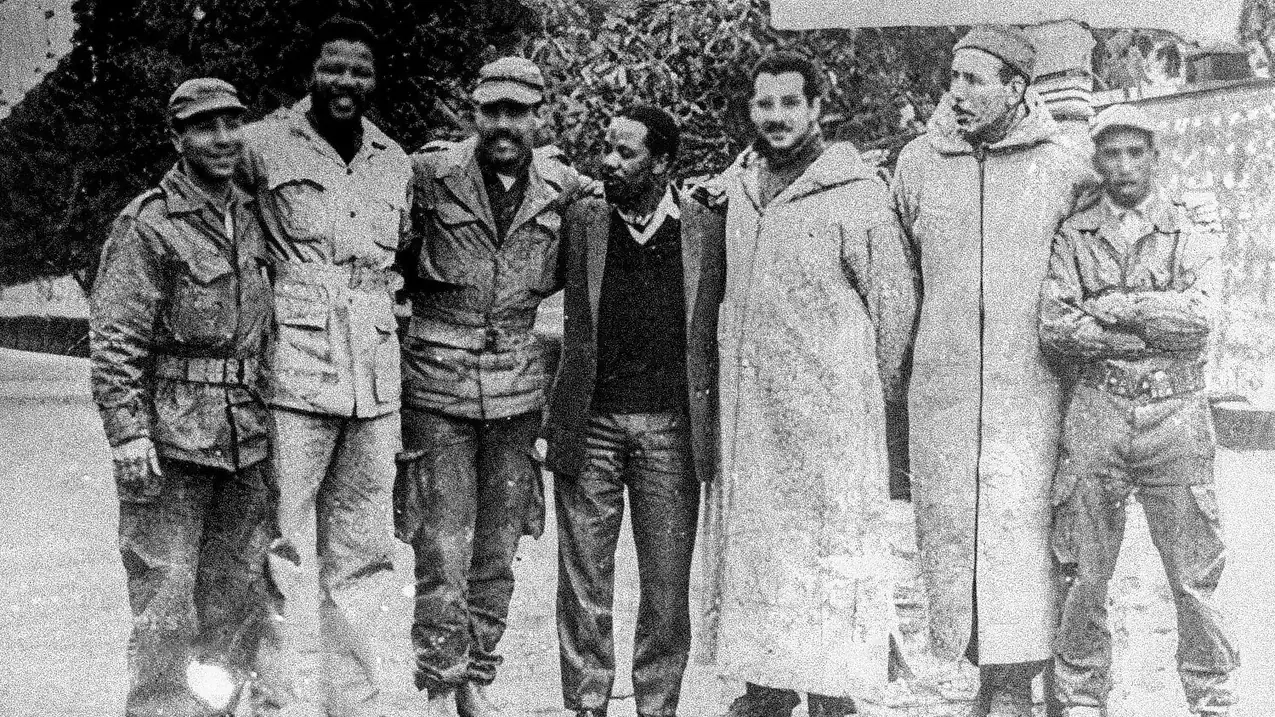
The radios of Cairo and Algiers are casting the king at that table as the accused. However, he is the son of the man who made Morocco the sanctuary of the Algerian revolution. It was at Oujda that the ALN’s Wilaya V installed its command, from Nador to Figuig that its rear bases ran, and on this same soil that Nelson Mandela had received, a year earlier, his first military training, before Ethiopia (we told the story of that sanctuary in Morocco for Africa).
Six weeks before Bamako, on September 19, 1963, the kingdom had signed the charter of the Organization of African Unity as a founding member. The radios see in it a jealous neighbor come to trouble a young revolution, while the record shows an ally of the war of independence who’ll discover at Bamako that the promise made to it will not be kept.
We will go back to 1845, when the commissioners at Lalla Maghnia wrote that in the Sahara any delimitation was superfluous, then follow France to Tindouf in 1934, Gara Djebilet’s iron, which gave this borderless territory a price, and the promise of July 1961, which the GPRA made to Morocco in writing. We will follow the two chronologies of October 1963, that of the desert outposts and that of the chancelleries, up to Bamako, where Africa stopped the fire without drawing the line, before counting those who came from elsewhere, from Havana to Cairo, and following the iron to the February 2026 train that carried its ore toward Oran.
Add to this that the Sand War of 1963 and the Western Sahara affair, opened in 1975, are two distinct wars on two distinct theaters. This one begins a century earlier, in a tent pitched near Maghnia.
A border nobody had drawn
Lalla Maghnia, 1845
On March 18, 1845, seven months after the defeat at Isly, the comte de La Rue for France and Si Ahmida ben Ali for Morocco signed at Maghnia the convention that was to settle the border between the two Empires, and that settled it in three registers.
In the north, in the Tell, it drew a true line, described marker by marker. In the middle country, it attached the tribes to one sovereign or the other according to their allegiances, without carving out any territory. Further down lay the ksour, gathered around their waters and palm groves, and article 5 assigned Ich and Figuig to Morocco by name. Last came the desert, before which the commissioners stopped:
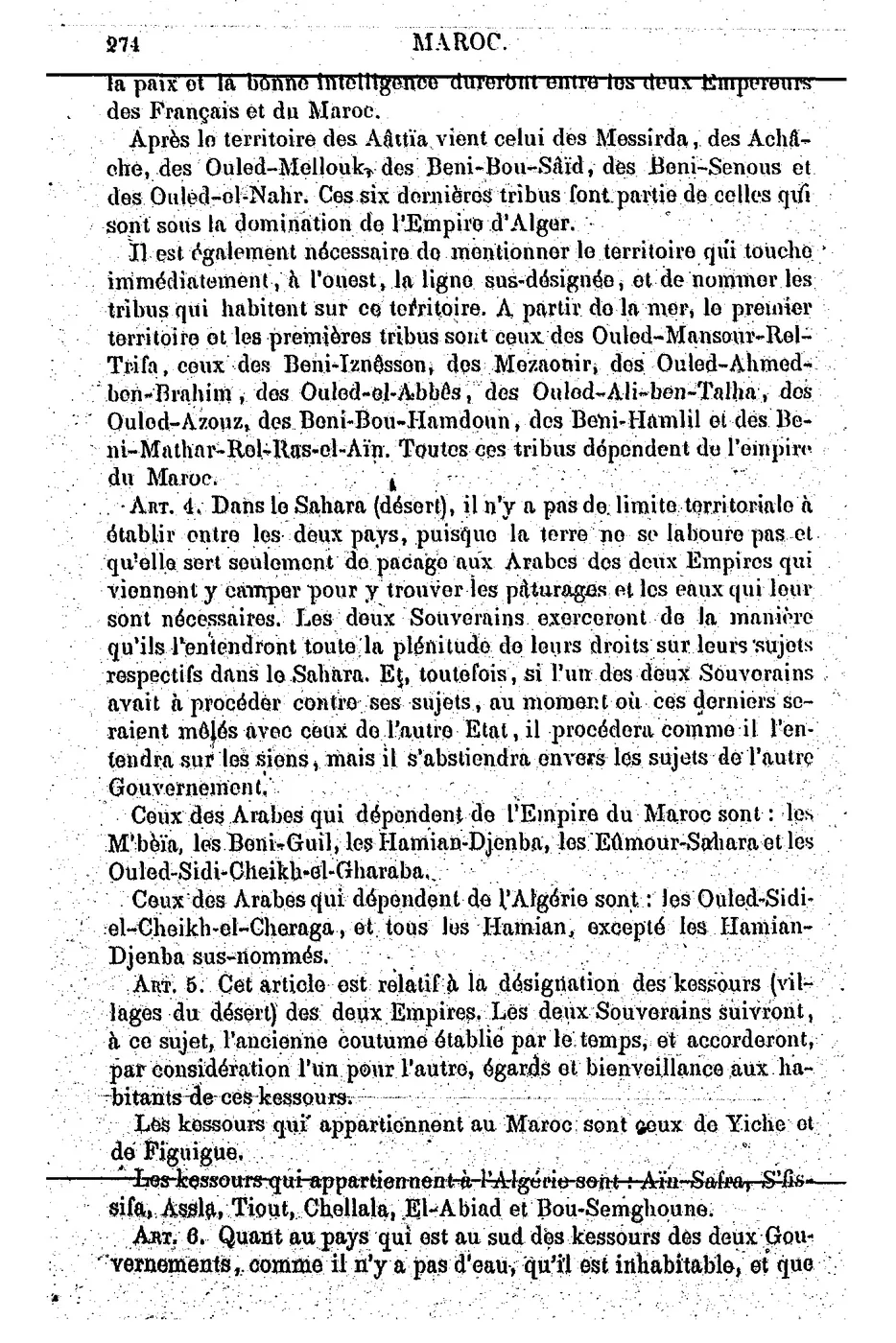
In the Sahara (desert), there is no territorial limit to be established between the two countries, since the land is not plowed and only serves as pasture for the Arabs of the two Empires who come to camp there to find the pastures and waters they need. The two Sovereigns will exercise as they see fit all the plenitude of their rights over their respective subjects in the Sahara.
— Convention of Lalla Maghnia, March 18, 1845, article 4 (de Clercq, Recueil des traités de la France, vol. 5)
Article 6 completed the gesture, ruling of the country south of the ksour that “since there is no water, as it is uninhabitable, and as it is the desert properly so called, the delimitation would be superfluous.” That word, superfluous, will have a long career. Tindouf is not named, the convention plants no marker and draws up no map, and for nearly a century that silence will serve in place of a border. Recall, for later, that Figuig had a written title.
Eleven in the morning, March 31, 1934
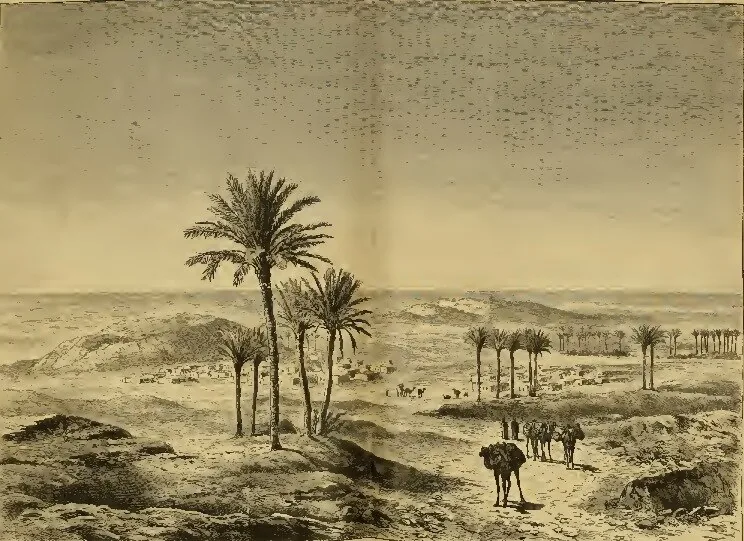
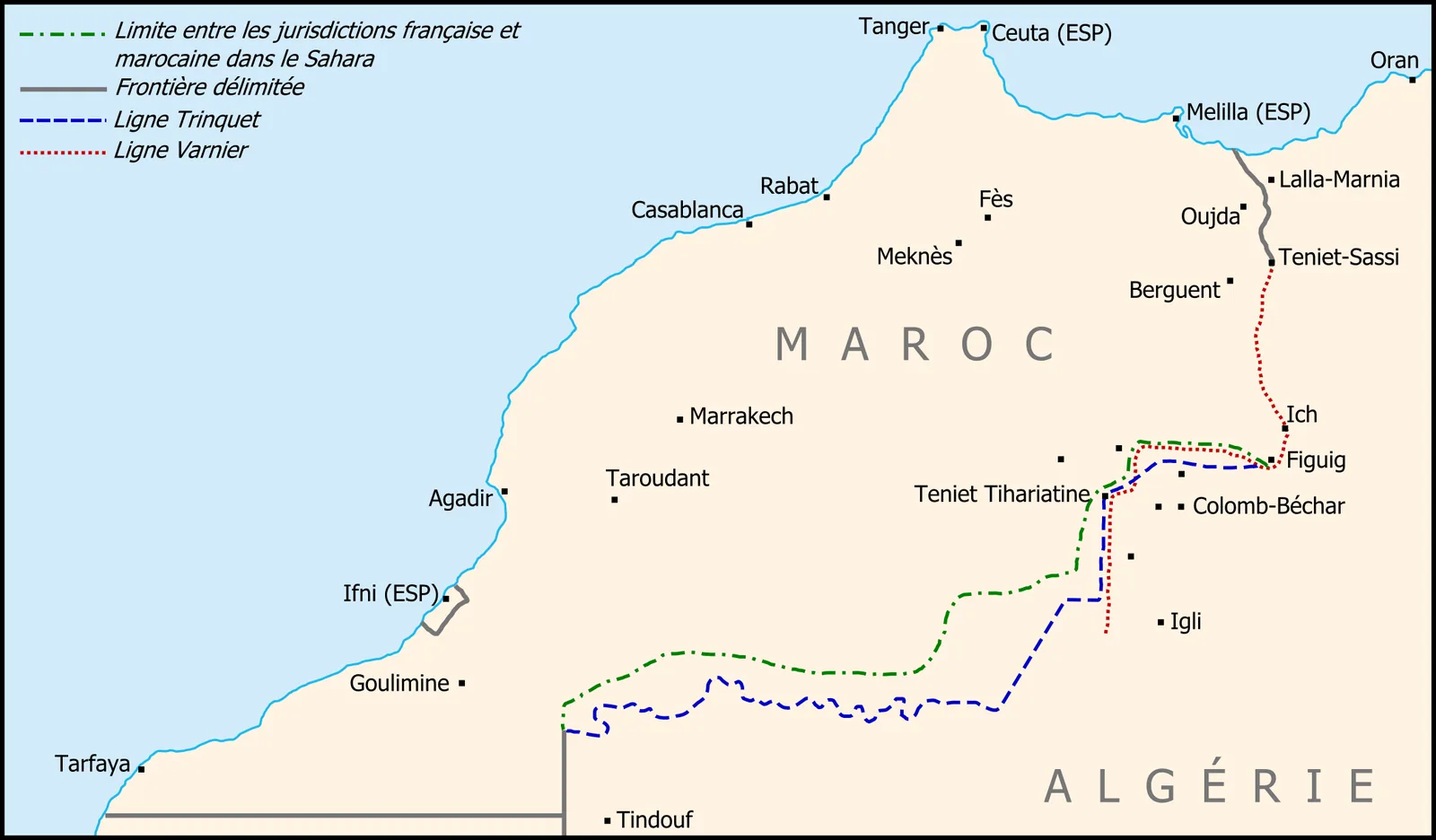
On March 31, 1934, at eleven in the morning, Colonel Trinquet entered Tindouf. The occupation was carried out, as the historian Olivier Vergniot has reconstructed, “in the name of France and of Algeria,” whereas the troops came from the Moroccan theater, where they were completing the subjugation of the Anti-Atlas. The ministerial instruction organizing the command of the borderlands, reread by Henry Marchat, came only on April 10, after the fact. With no treaty and no proclaimed conquest, this simple administrative act thus placed under Algiers a desert that 1845 had left to allegiances, and it is this attachment that Algiers will invoke in the age of independences.
When the desert acquired a price
Around 1952, geologists confirmed that southeast of Tindouf, at Gara Djebilet, the hamada was hiding one of the largest iron deposits on the continent. What remained, then, of the delimitation that Lalla Maghnia had judged superfluous?
The law of January 10, 1957 created the Common Organization of the Saharan Regions, and Paris carved out the departments of the Oasis and the Saoura the same year. The shared pasture of the two Empires was thus cut into districts, budgets and mining titles.
In short, France spared itself the trouble of drawing the border, administering everything itself, and on its departure Rabat and Algiers will find themselves face to face, with neither line nor arbiter.
October, two chronologies
Tindouf, October 1962
The war, in any case, began before 1963, since from August 1962 on, Flory notes, “border incidents multiplied, in the Tindouf region especially.” In July, Morocco had pushed its administration out to the post of Zegdou, on the Tindouf axis. On October 9, 1962, as Edouard Meric records, the Algerian army will occupy Tindouf and drive out by force the local representatives of the Moroccan government who refused to leave, and there were dead and wounded. One year, almost to the day, before the battles of 1963, the first blood of this border was thus spilled at Tindouf, when Algerian independence was not yet three months old…
September 25 and October 8
When did the war break out? The record does not allow a ruling, and we will not issue one in its place, for “No commonly accepted version exists,” as Lyes Si Zoubir will write in Maniere de voir.
The Algerian chronology, followed by much of the English-language scholarship, places in late September the occupation by about a thousand Moroccan soldiers of the posts of Hassi Beida and Tinjoub, on the track through the borderlands. That of the chancelleries keeps October 8, the first day of two-way combat, which left about ten dead that day (ten killed and thirty-five wounded, the Moroccan information minister will specify), the only figure that can be dated with certainty.
Between the two dates, on October 5, at Oujda, Reda Guedira and Abdelaziz Bouteflika agreed once more to create a joint commission to examine the border problem. The next meeting, set for Tlemcen on October 11, convened without the Moroccans, and the Algerian delegation waited there in vain, Flory writes.
Algiers, however, had let it be known through its “authorized circles” that the line of the border was not to be raised there and that only the movement of border populations was to be discussed. Rabat, for its part, was letting it be known that a summit could only take place on an agenda “based on the discussion of the substance of the border dispute.” Each side was thus setting a condition the other refused, and three days later, the Royal Armed Forces will retake the two posts.
The two mobilizations
Each capital went to war with its own enemies at home. As early as September 30, before the first acknowledged clash, Ben Bella was denouncing on the radio the collusion of the Moroccan government with the Front of Socialist Forces that Hocine Ait Ahmed had just founded in Kabylia. The FLN’s organ had been calling the king, since September 8, a “puppet in the hands of an oligarchy animated by an apprentice Rasputin.”
Two days before mobilizing, the president was still playing for calm before the press: “we are keeping our serenity here. These problems can only be resolved through dialogue.” On October 15, before a hundred thousand people gathered at the Forum in Algiers, he will proclaim the “general mobilization of all former djounoud,” declare himself convinced of collusion between “the people of Morocco and those of Tizi-Ouzou,” and throw out: “Algeria will crush every imperialism.”
The same day, the Algerian Assembly denounced an aggression designed to “thwart the socialist policy” of the government. Radio Algiers will soon call on the kingdom’s soldiers to disobey (“Moroccan djounoud, disobey Hassan II”). In the last days of October the Kabyle maquis of Mohand ou el-Hadj came down to rally to the army and left for the front, thus closing the only armed dissidence that worried the regime. The border war was becoming, in Algiers, a war of the revolution.
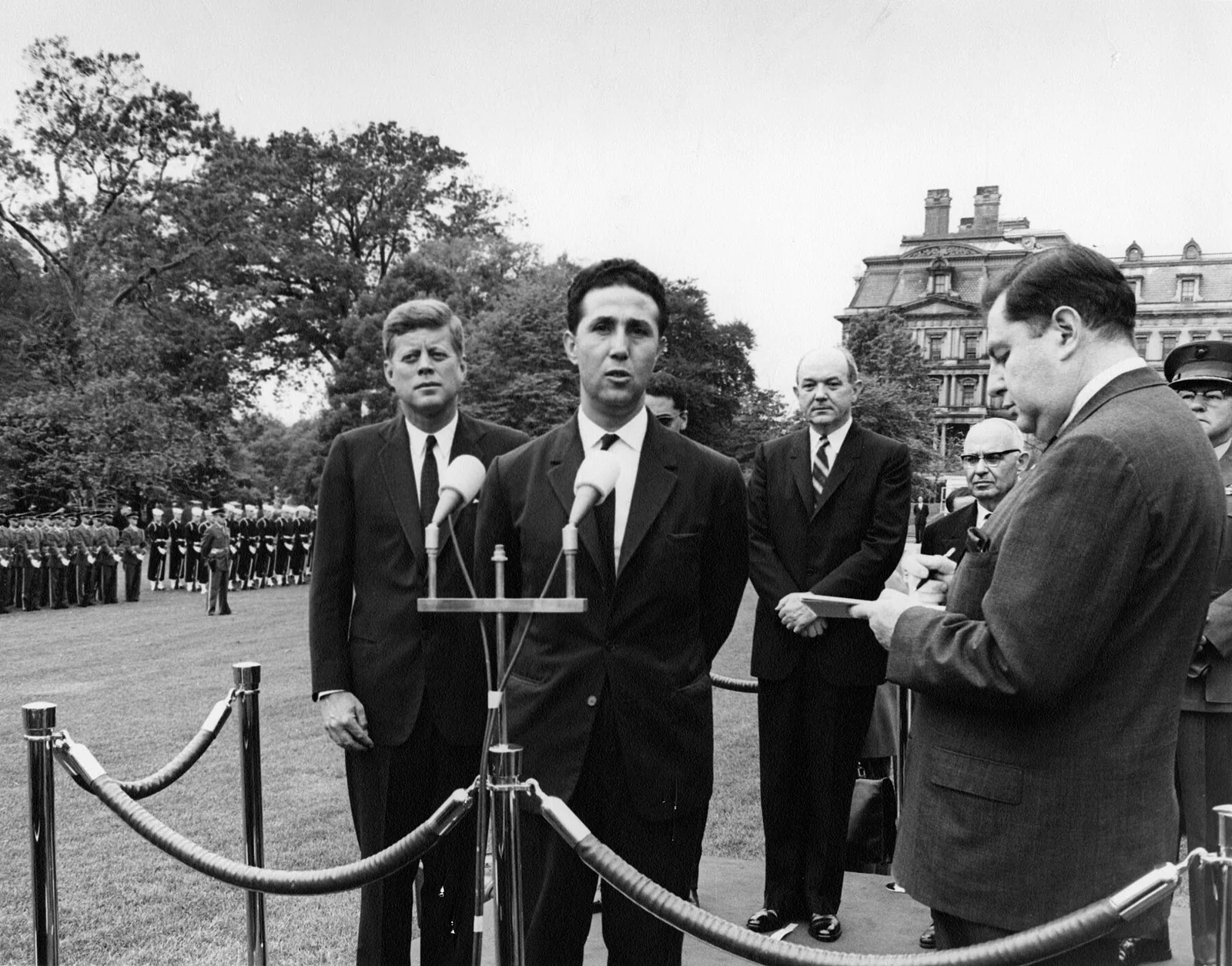
It is to this Forum speech that Algerian memory attaches the most famous cry of the war: “Hagrouna!”, they have humiliated us. Now, we have looked for that cry everywhere it ought to have left a trace, and we found it neither in the scholarly chronologies of the period, nor in the press of 1963, nor in a dated recording.
Ben Bella will claim authorship of it in 2002, on Al Jazeera, and the memoirs of chief of staff Tahar Zbiri and of Chadli Bendjedid will lend it to him half a century after the fact. Finally, the recording that circulates under that name today is a 1999 Bouteflika speech at Annaba, in which the man who had been a minister in 1963 concedes himself that Ben Bella “perhaps” said it. The most famous word of this war has reached us only through late testimony.
Morocco will mobilize on October 10, and Hassan II will speak that same day before the municipal council of Agadir:
The duty of the State and of the people is to stand ready to defend the country.
— Hassan II, before the municipal council of Agadir, October 10, 1963 (our translation)
The Moroccan people, he had also said, “will not accept any compromise on our sacred principles, our authentic borders and our national dignity.” On the 17th he cabled Ben Bella that Morocco was “ready to face any eventuality,” and on the 22nd, the chronicles record volunteers in towns across the kingdom asking to enlist in the FAR.
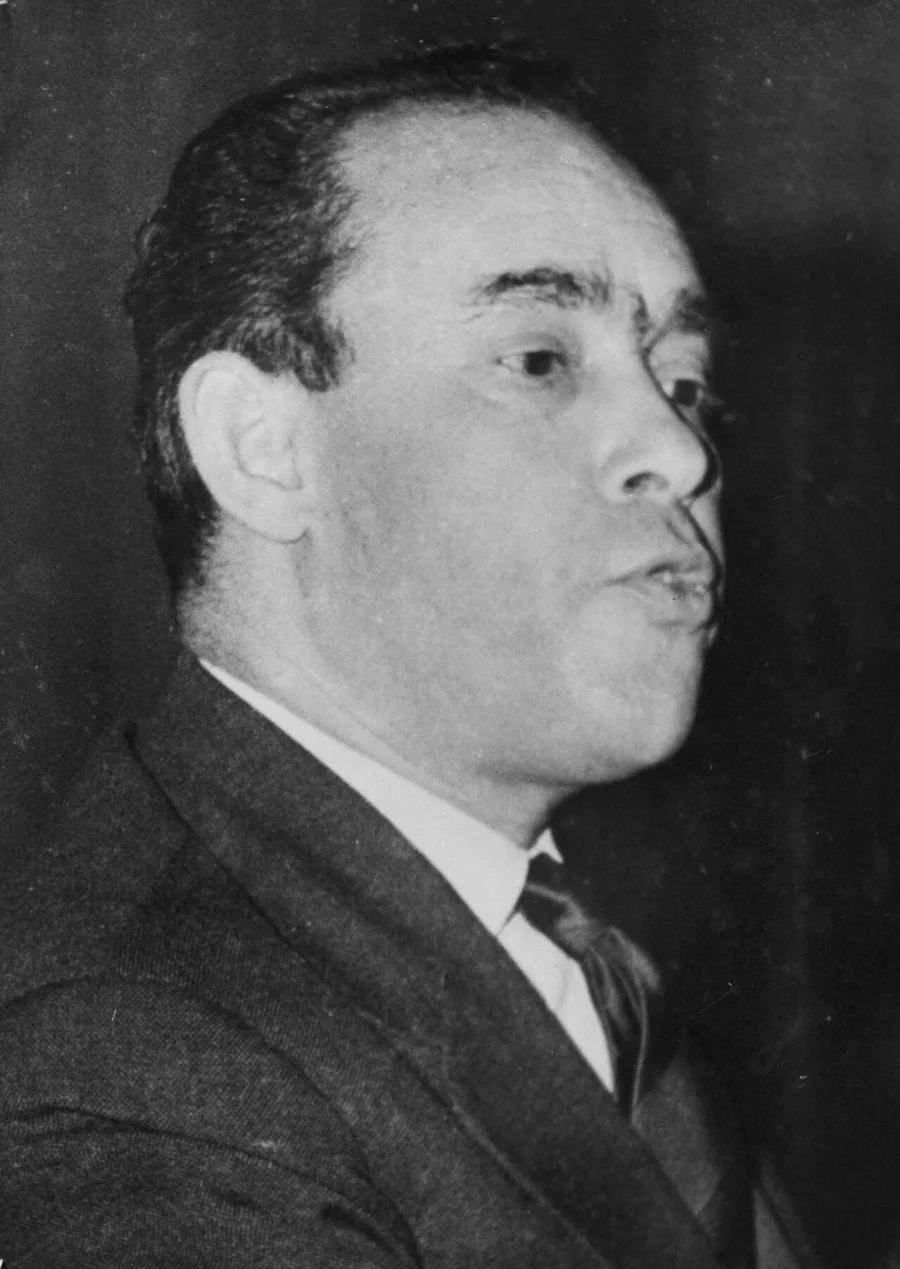
The Moroccan sacred union had its tear as well, since Mehdi Ben Barka, leader of the UNFP, declared his solidarity with Algeria from Cairo. On both sides, Flory concludes, this war, “by creating a climate of sacred union,” gave both governments “the occasion to consolidate themselves.” One difference, however, separates the two capitals, for Morocco was claiming the negotiation that the 1961 protocol had promised it in writing, and whose opening Algiers kept putting off.
Hassi Beida, Tinjoub, Ich, Figuig
Thus, on October 14, the FAR retook Hassi Beida and Tinjoub. On the ground, Moroccan artillery and armor faced an Algerian infantry that had emerged victorious from a guerrilla war but was a stranger to positional warfare.
Having rated Hassan “the likely loser” should the affair escalate, the Americans nonetheless observed that the Moroccans held both disputed oases, and one press report even had them marching on Tindouf. The FAR will enter neither Tindouf nor Gara Djebilet, and the iron will thus stay out of the war. The French ambassador in Washington ascribed two possible designs to Morocco, seizing a few advanced points in order to force a negotiation, or securing Tindouf and its ore, and only the first will come to pass.
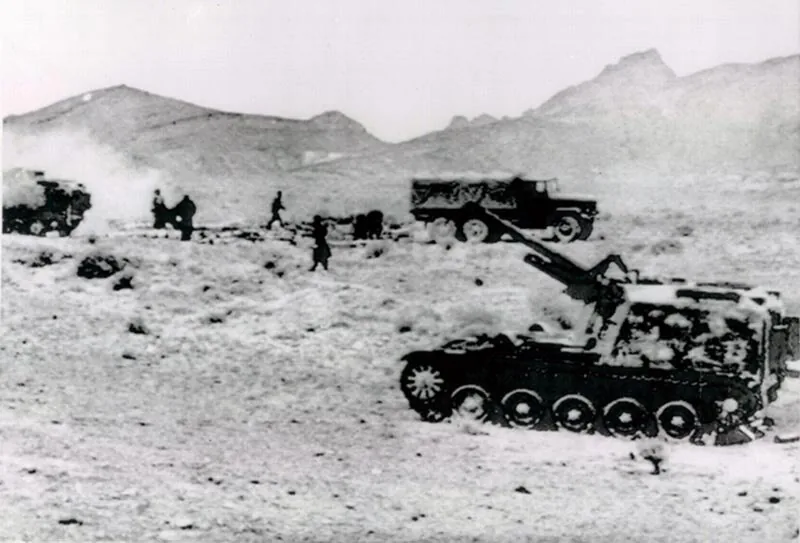
Toward mid-October a second front opened in the north, at Ich and next around Figuig, in ksour that article 5 of Lalla Maghnia had assigned to Morocco in so many words. On October 20, near Ain Chouateur, the FAR will seize a Soviet-made helicopter carrying Egyptian and Algerian officers. Four of the five captured Egyptian officers were presented to the press, and Morocco’s delegation to the UN issued a communique about them. Cairo hardly hid its hand, and on November 1, Mohamed Hassanein Heikal, editor of Al-Ahram and Nasser’s confidant, will confirm that Egypt had sent armor and naval units to Algeria.
After the Bamako signature, Figuig was shelled again, and the town held. The king, back from Bamako by way of Dakar, declared on the radio that Morocco “will not answer violence with violence,” ordered his troops to avoid all contact with the Algerians, and cabled that assurance to the Negus, to Modibo Keita and to U Thant.
Ben Bella, for that matter, won’t deny it, since on the evening of November 1 he will state that the Algerian army “was already at Figuig before the Bamako conference,” before swearing a few days later, on Radio Luxembourg: “We never occupied Figuig.” Komer wrote it to McGeorge Bundy on November 4:
Hard to sort out who’s firing at whom, but Figuig seems still in Moroccan hands. Most fascinating question is whether Boumedienne at the front is taking orders from Algiers.
— Robert W. Komer to McGeorge Bundy, November 4, 1963 (FRUS, XXI, doc. 29)
Ambassador Bengelloun will tell the Americans that an attempt had been made, with UAR help, to take a Moroccan town lying behind “a frontier which has never been contested.”
Bamako did not draw the line
October 26
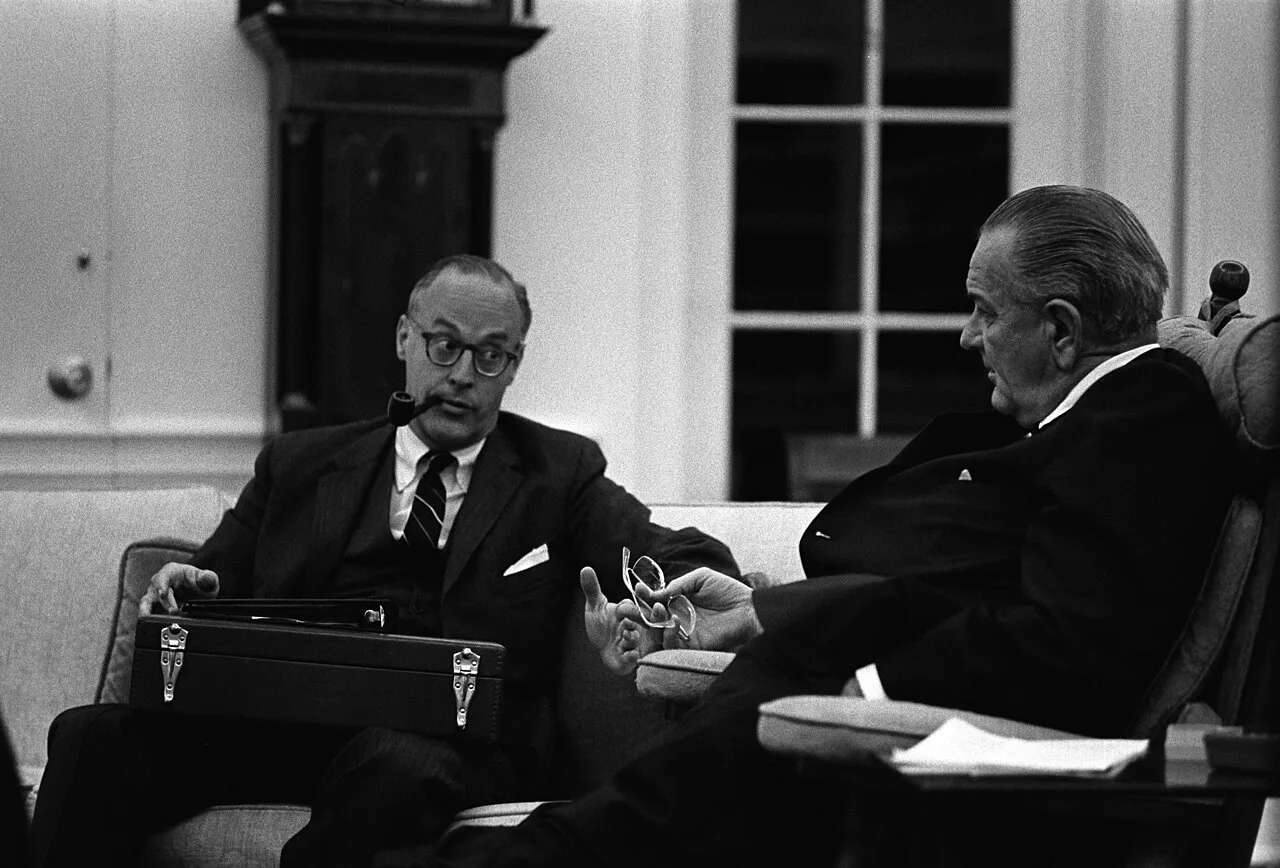
During the fighting, the chancelleries were busy, and Kennedy wrote to both capitals on October 27, pressing Hassan II to seek “a solution through negotiation rather than war” and confiding to Ben Bella his fear that a border dispute might become “a far graver conflict between philosophies or systems.”
Washington had held up a 10 million dollar loan to Rabat while it took stock. It nonetheless knew where the merits lay, since as early as October 20 Hassan II had told Ambassador Ferguson that Morocco had “no aggressive intentions” and remained “ready to discuss the frontier problem before any international body.” On November 1, in an internal note, Komer will write that on his border claims against Algeria, Hassan “has a good case.”
The good offices of Haile Selassie and Modibo Keita produced, on October 26, the two parties’ acceptance of a meeting at Bamako. The king will go there while holding the disputed oases, when he could have played for time and let his advantage run.
Four points, zero marker
On October 29 and 30, 1963, under the Negus’s chairmanship, the four heads of state settled a communique whose every clause deserves weighing. It provided for a cease-fire “effective November 2, 1963 at midnight,” a commission of Moroccan, Algerian, Ethiopian and Malian officers to determine the zone from which troops would withdraw, and Ethiopian and Malian observers in order to guarantee its neutrality.
A meeting of the OAU’s foreign ministers, finally, was to set up an arbitration commission in Addis Ababa whose first task was to “situate responsibility for the outbreak of hostilities,” and whose second was to study the substance of the problem. Add to these a clause that is little cited, the halt, from November 1 at midnight, “of all public attacks, including through the press.”
The four points were hailed as an African triumph (the first war between independent states of the continent, the first cease-fire obtained without the UN and without the great powers). However, American intelligence saw the limit at once, which Thomas L. Hughes named for Dean Rusk on October 30:
The agreement to establish a demilitarized zone does not solve the critical question—whether or not Hassan will withdraw from Tinjoub and Hassi Beida.
— Thomas L. Hughes (INR) to Dean Rusk, October 30, 1963 (FRUS, XXI, doc. 26)
Rabat had answered in advance, through Ahmed Balafrej: “We will evacuate neither Hassi Beida nor Tinjoub.” Bamako had fixed the hour of the cease-fire and handed the line to the commission, thus sending the substance back to Addis Ababa.
The commission charged with saying who had started it will not say, the OAU preferring not to name a culprit, and Washington noted that responsibility for the outbreak was “probably shared” by both parties. Those who speak today of a Moroccan aggression judged by Africa are thus citing a verdict the arbitration commission did not deliver.
Addis, and after
On the ground, the fire will only truly go out on November 5, around Figuig and Beni Ounif, when the Malian captain Leon Sankare, delegated to supervise the cease-fire, got both lines to stop shooting: “I made contact with the Algerian and Moroccan authorities at 9:30, and both sides confirmed to me that the firing and the fighting were stopping for good. […] The troops remain on their positions.”
The dispute itself will stay African, for Rabat sounded out New York and Washington answered that Bamako should be honored. From November 15 to 18, the ministers meeting in Addis Ababa thus enlarged the ad hoc commission to seven countries.
The doctrine of borders inherited from colonization, so often invoked against Rabat, will come later. It was indeed in Cairo, in July 1964, that the OAU will vote it, nine months after the fighting, and it does not apply backwards.

On November 18, 1963, opening the first Parliament of his reign, Hassan II gave the events their Moroccan name:
The cruel and painful events our country lived through, following an aggression perpetrated against our territory, obliged us to face them in order to defend our dignity and protect the integrity of the national soil.
— Hassan II, speech opening Parliament, Rabat, November 18, 1963 (our translation)
On February 20, 1964, an implementation meeting organized the withdrawal and the observers. In the night of April 14 to 15, 1964, the prisoners will be exchanged, Algeria returning fifty-seven Moroccans while Morocco returned three hundred and seventy-nine Algerians.
As for the dead, the record forbids a total. Morocco officially acknowledged thirty-nine killed, and Flory, as early as 1965, wrote of “several hundred dead and wounded” across all the battles. It will take until 2021, fifty-eight years after the fact, for Algeria to put forward “more than eight hundred and fifty martyrs,” through the voice of the minister who was announcing, in the same breath, the rupture of diplomatic relations with Rabat. A figure produced on that day cannot stand as a toll, and we will keep to the ranges.
Those who did not fire
The brigade that did not fire
Then there were the others, all those who came from elsewhere, starting with the Cubans, whose affair the historian Piero Gleijeses has definitively established. Six hundred and eighty-six men and twenty-two T-34 tanks will land for Ben Bella under the command of Efigenio Ameijeiras, ready around October 28. An operation against Berguent, christened Operacion Dignidad, was prepared and then canceled, and the brigade will not fire a single shot.
Rabat, for its part, did not wait for the historians, since on October 31, 1963, Ahmed Balafrej announced the rupture of diplomatic relations with Havana and, in the same breath, the recall of Morocco’s ambassadors to Damascus and Cairo. In Washington, the prospect of Cuban arms in Algeria drew from Dean Rusk, according to his aides, the remark that if those people took arms from Cuba, “we’ll just have to back Morocco.” Received by Kennedy on November 8, Yazid acknowledged the Soviet and Cuban equipment without mentioning Egypt, whose officers captured at Ain Chouateur had supplied the proof.
The distant captains
The most committed was Cairo, which sent arms, notably the armor and naval units Heikal will confirm, officers all the way to the front, and, according to the reports reaching the White House on October 24, Nasser decided to help Ben Bella “in a big way,” troops included. A month later the same White House will judge that the UAR had hardly shone and that the Cuban role had stayed “minor, though symbolic.”
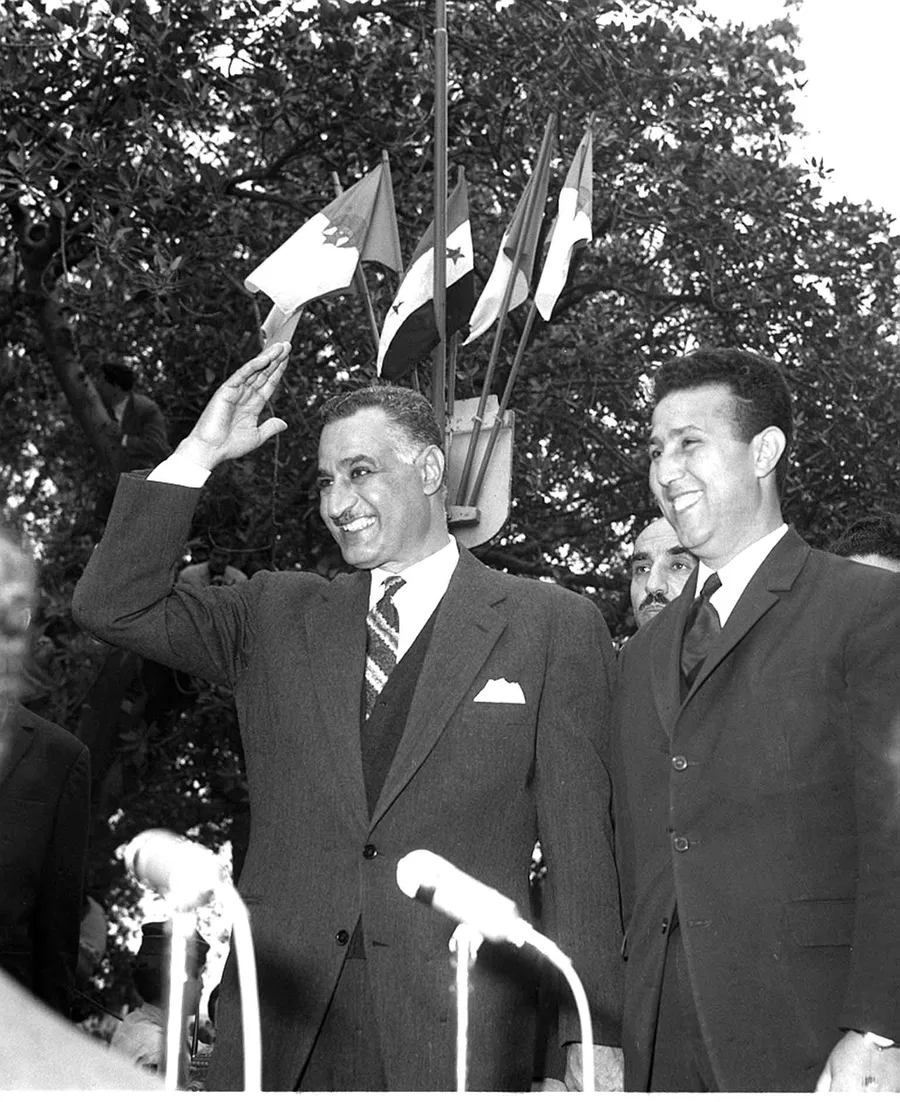
Despite the rumors, Moscow did not send an expeditionary corps. Paris, which Washington suspected of sending ammunition and food to Morocco, officially held to non-intervention. The Americans themselves delivered to Rabat, at night and in cordoned areas, the munitions of a program signed earlier, while asking themselves in their notes: “if we and French are still supplying Moroccans, how can we tell Nasser not to equip Algerians?”
The Chinese loan to Algeria stood apart from October’s shooting, and the month was played out between two Maghreb armies.
Thus, Algeria received Cuban tanks, Egyptian armor and Soviet arms, while Washington sent Morocco letters and counsels of moderation and held up its 10 million dollar loan. The third-worldisms had picked their side before the first shot, and the FAR still held Hassi Beida and Tinjoub when Bamako was signed.
What the sand did not close
Ifrane, Tlemcen, Rabat
The line will come by treaty, long after, and it was at Ifrane, on January 15, 1969, that a treaty of friendship was signed, before a political path opened, on May 27, 1970, at Tlemcen. On June 15, 1972 at last, at Rabat, before the delegations assembled for the OAU summit, two conventions will be signed, one delimiting the border, the other organizing the joint development of the Gara Djebilet iron.
Hassan II and Boumediene proclaimed that day their intent to establish “a permanent peace for the centuries to come.” Morocco will bear the cost, for Tindouf and Bechar remained Algerian, and the Algerian preamble drove the nail home:
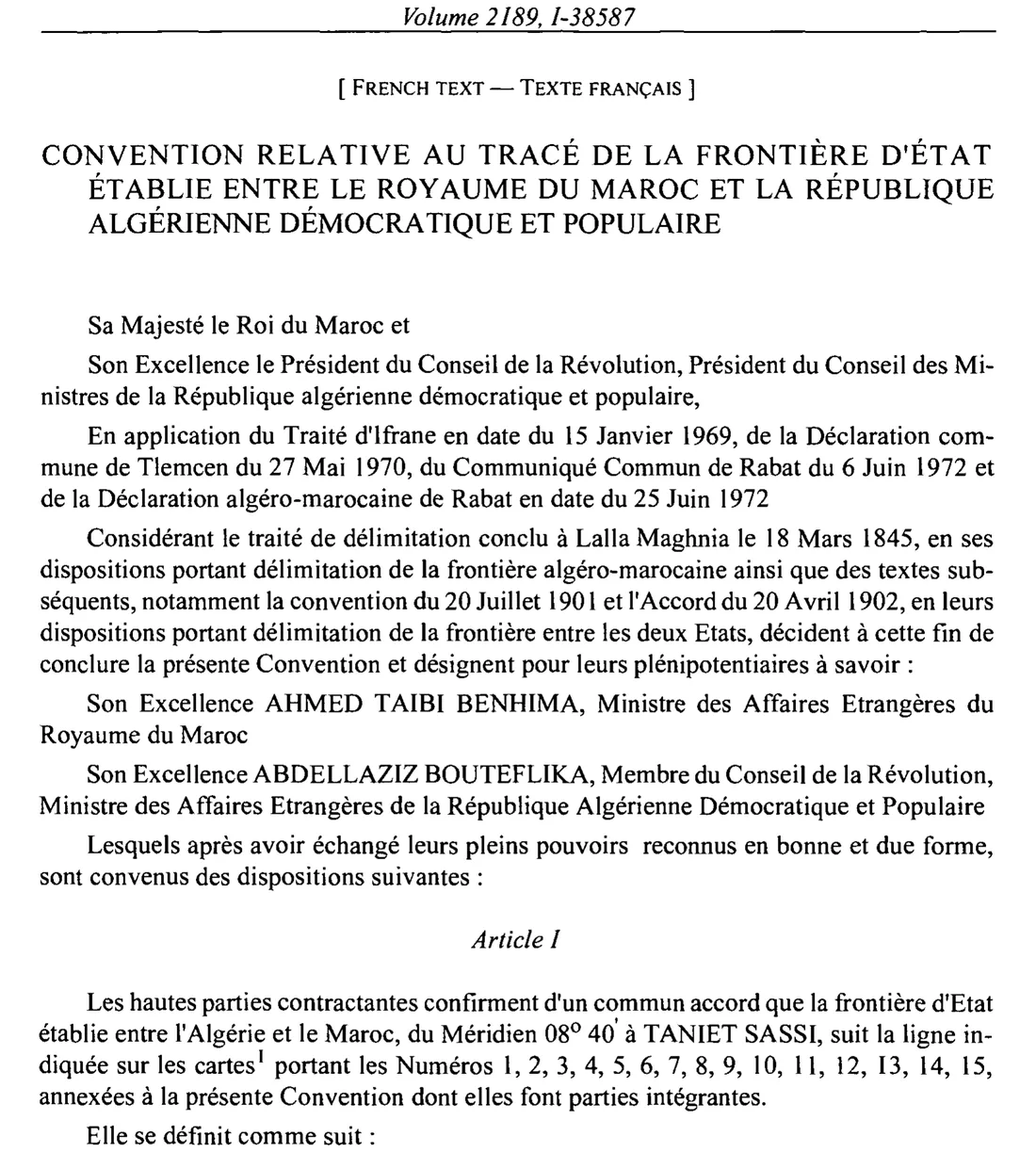
Considering that Algeria is the owner of the Gara-Djebilet iron ore deposit, situated on its territory and falling under its full and entire sovereignty
— Journal officiel of the Algerian Republic, June 15, 1973 (our translation)
In exchange, a joint company owned in equal shares was to work the ore, which was to ship out through Morocco’s Atlantic ports. Algeria ratified as early as 1973, whereas Morocco, which had conceded everything and was waiting for its quid pro quo, gave the border convention force of law only much later. The latter entered into force in the United Nations treaty series only on May 14, 1989, seventeen years after the signature, and it was only on June 22, 1992 that it was published in the Bulletin officiel.
Another war
In 1975 the Western Sahara affair opened, on another theater, with other actors and under another body of law. Tindouf will become a rear base in it, though one cannot see in this the logical sequel to Hassi Beida, nor reread October 1963 in the light of Madrid.
Official Algeria teaches today that borders are drawn, before anything else, by “the cemeteries of the martyrs,” in the formula of its state radio. Morocco has always invoked the allegiances binding the tribes to the Throne, long before France invented its departments, and these two readings still await a commission to arbitrate between them.
The train of February 1, 2026
As for the iron, the joint company of 1972 will not see the light of day. Abdelhadi Boutaleb, then foreign minister, will recount that Hassan II asked him to handle the file “with diligence” so that the mine would reach “its implementation phase,” and that he did not manage to obtain the promised meeting with his counterpart Bouteflika.
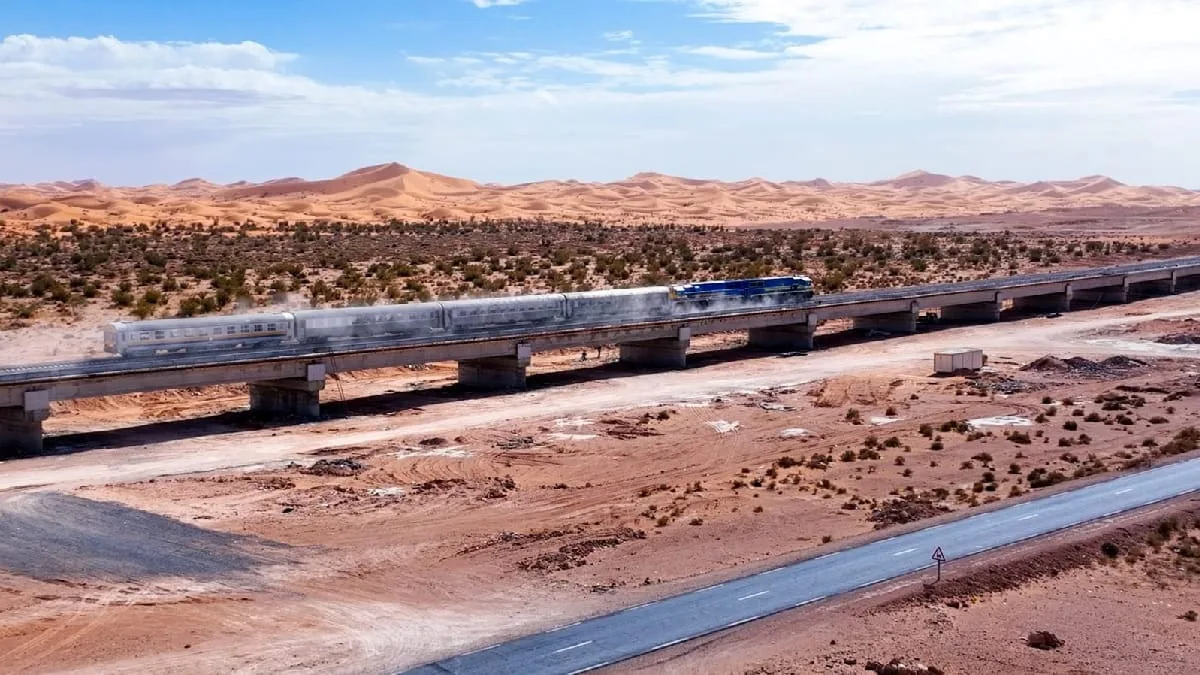
The deposit lay unworked for half a century, before Algeria ended up developing it alone. It signed a memorandum with a Chinese consortium in March 2021, laid the first stone of the processing plant in November 2023 and inaugurated, on February 1, 2026, at Bechar, a 950-kilometer railway, with the departure of the first ore train from Gara Djebilet toward Oran, on Chinese rails, bound for a Turkish steel mill. Fifty-three years after the Rabat signature, the desert’s iron has thus taken the road, without a Moroccan share in a single railcar.
- Convention de Lalla Maghnia, 18 mars 1845, articles 4, 5 et 6 — de Clercq, Recueil des traités de la France, t. 5; texte collationné sur Rouard de Card, Les traités entre la France et le Maroc (1898); traduction anglaise des articles 4 et 6 d'après Palotás (2023).
- Protocole d'accord entre le Gouvernement de Sa Majesté le Roi du Maroc et le Gouvernement provisoire de la République algérienne, Rabat, 6 juillet 1961 — Annuaire de l'Afrique du Nord, vol. II (1963), CNRS, Documents V-6, p. 1012–1013. Sur la date de publication par Rabat (21 ou 22 octobre 1963), les sources divergent d'un jour; l'en-tête «2 septembre» du même Annuaire est isolé.
- Communiqué commun de Bamako, 30 octobre 1963 — Annuaire de l'Afrique du Nord 1963, Documents V-7, p. 1014–1015.
- Discours de S.M. Hassan II à l'ouverture du Parlement, 18 novembre 1963 — Annuaire de l'Afrique du Nord 1963, Documents Maroc, p. 897; discours d'Agadir du 10 octobre 1963 et télégramme du 17 octobre, chronologies du même volume (p. 475, 483).
- Maurice Flory, «Chronique diplomatique», Annuaire de l'Afrique du Nord 1963, p. 331–359 (conflit algéro-marocain: p. 335–339); «Chronologie, vie diplomatique», même volume, p. 475–497 (réunion de Tlemcen, hélicoptère d'Aïn Chouateur, rupture avec Cuba, déclarations des 1er et 2 novembre, capitaine Sankaré).
- «Notre Sahara», El Moudjahid n° 83, 19 juillet 1961 (communiqué commun Maroc–GPRA).
- Ferhat Abbas, Autopsie d'une guerre: l'aurore, Garnier, 1980 (rééd. Alger-Livres, 2011, p. 305).
- Mohammed Harbi, Les Archives de la révolution algérienne, Jeune Afrique, 1981, docs 56, 85 et 93.
- Foreign Relations of the United States, 1961–1963, vol. XXI, Africa — docs 8, 12, 13, 15, 17, 19, 22, 23, 24, 26, 27, 28, 29, 31, 33, 34 et 89 (history.state.gov).
- CIA, Office of Current Intelligence, Background of Moroccan-Algerian Border Skirmishes, 29 octobre 1963; The President's Intelligence Checklist, 16 octobre 1963 (archives déclassifiées).
- Édouard Méric, «Le conflit algéro-marocain», Revue française de science politique 15-4 (1965), p. 743–752.
- Olivier Vergniot, «Tindouf, un point d'équivoque (1912–1934)», REMMM 41–42 (1986).
- Henry Marchat, «La frontière saharienne du Maroc», Politique étrangère 22-6 (1957).
- Alf Andrew Heggoy, «Colonial Origins of the Algerian-Moroccan Border Conflict of October 1963», African Studies Review 13-1 (1970), p. 17–22.
- Ana Torres-Garcia, «US diplomacy and the North African "War of the Sands" (1963)», Journal of North African Studies 18-2 (2013), p. 324–348; et Historia de las relaciones exteriores de Marruecos independiente, thèse, Université de Séville, 2010.
- Piero Gleijeses, Conflicting Missions (University of North Carolina Press, 2002) et Journal of Latin American Studies 28-1 (1996).
- Karen Farsoun et Jim Paul, «War in the Sahara: 1963», MERIP Reports 45 (1976), p. 13–16.
- László J. Nagy, «Conflit frontalier entre l'Algérie et le Maroc», West Bohemian Historical Review XIV-2 (2024).
- Lyes Si Zoubir, «La "guerre des sables"», Maniere de voir n° 181, février-mars 2022, p. 12.
- Martin Evans, «Sand War: The Cold War in North Africa», History Today 74-2, février 2024.
- Hassan Aourid, «La guerre des sables, 60 ans après», Zamane n° 155, novembre 2023; «Il y a 60 ans, Rabat et Alger s'échangent les prisonniers», Zamane, 9 avril 2024.
- Benjamin Stora, cité in D. Lounnas et N. Messari, Algeria–Morocco Relations, MENARA Working Paper 20 (2018), p. 5; Benjamin Badier, Mohammed V, dernier sultan et premier roi du Maroc, Perrin, 2025 (dispositif du sanctuaire).
- Charles-Robert Ageron, «Un versant de la guerre d'Algérie: la bataille des frontières (1956–1962)», Revue d'histoire moderne et contemporaine 46-2 (1999); Malika Rahal et Benjamin Thomas White, «UNHCR and the Algerian war of independence», Journal of Global History 17-2 (2022) (chiffres des réfugiés).
- «L'affaire du F-OABV (Maroc c. France)», Annuaire français de droit international, vol. 4 (1958), p. 282 (détournement du 22 octobre 1956).
- Conventions de Rabat du 15 juin 1972 (frontière; coopération Gara-Djebilet) — Journal officiel de la République algérienne, 15 juin 1973; Recueil des traités des Nations unies, n° 38587 (entrée en vigueur le 14 mai 1989); Bulletin officiel du Royaume, 22 juin 1992; témoignage d'Abdelhadi Boutaleb rapporté par Yabiladi, 1er avril 2021.
- Ramtane Lamamra, conférence de presse du 24 août 2021 (bilan algérien «plus de 850 martyrs», première annonce officielle — 24H Algérie, 25 août 2021); Radio algérienne, dossier du 1er septembre 2021 (récit officiel algérien).
- Bloomberg News (Salah Slimani), «Algeria opens 600-mile railway to tap vast iron ore deposit», 1er février 2026; communiqués officiels algériens (APS) sur Gara Djebilet, 2021–2026.
- Charte de l'Organisation de l'unité africaine (25 mai 1963; signature marocaine du 19 septembre 1963, Recueil des traités des Nations unies, vol. 479); AHG/Res. 16 (I), Le Caire, juillet 1964, citée comme doctrine postérieure.
- Le Monde, dépêches d'octobre-novembre 1963 (éditions des 21, 22, 24 et 25 octobre; 4 et 6 novembre), dont l'appel de Radio-Alger du 18 octobre; Jeune Afrique, «Ce jour-là: le 5 novembre 1963, la guerre des Sables prenait fin» (rencontre d'Oujda du 5 octobre, fin des combats).
- Sur le cri «Hagrouna» et son absence des sources de 1963: Tahar Zbiri, Nisf qarn min al-kifah (نصف قرن من الكفاح), Échorouk, Alger, 2011, p. 44 et 46; Chadli Bendjedid, Mémoires, t. 1, Casbah, 2012; Ahmed Ben Bella, entretiens «Chahid ala al-asr», Al Jazeera, 8 et 15 décembre 2002; discours d'Abdelaziz Bouteflika à Annaba, 1999 (rediffusion Ennahar TV).
- Photo credits — Horace Vernet, La Bataille d'Isly (1846), public domain · portraits of Ferhat Abbas (1959), Ahmed Ben Bella (1961) and Haile Selassie: Anefo collection, Nationaal Archief (CC0) · Hassan II and John F. Kennedy in Washington (March 27, 1963): Marion S. Trikosko, Library of Congress, public domain · Modibo Keita (1961): Cecil Stoughton, White House, public domain · Figuig palm grove: Mohammed Abdeljalil (CC BY-SA 4.0) · Hassi Mounir and Tindouf: Habib Kaki (CC0) · lead image: Hassan II in uniform (1961), Anefo (CC0).