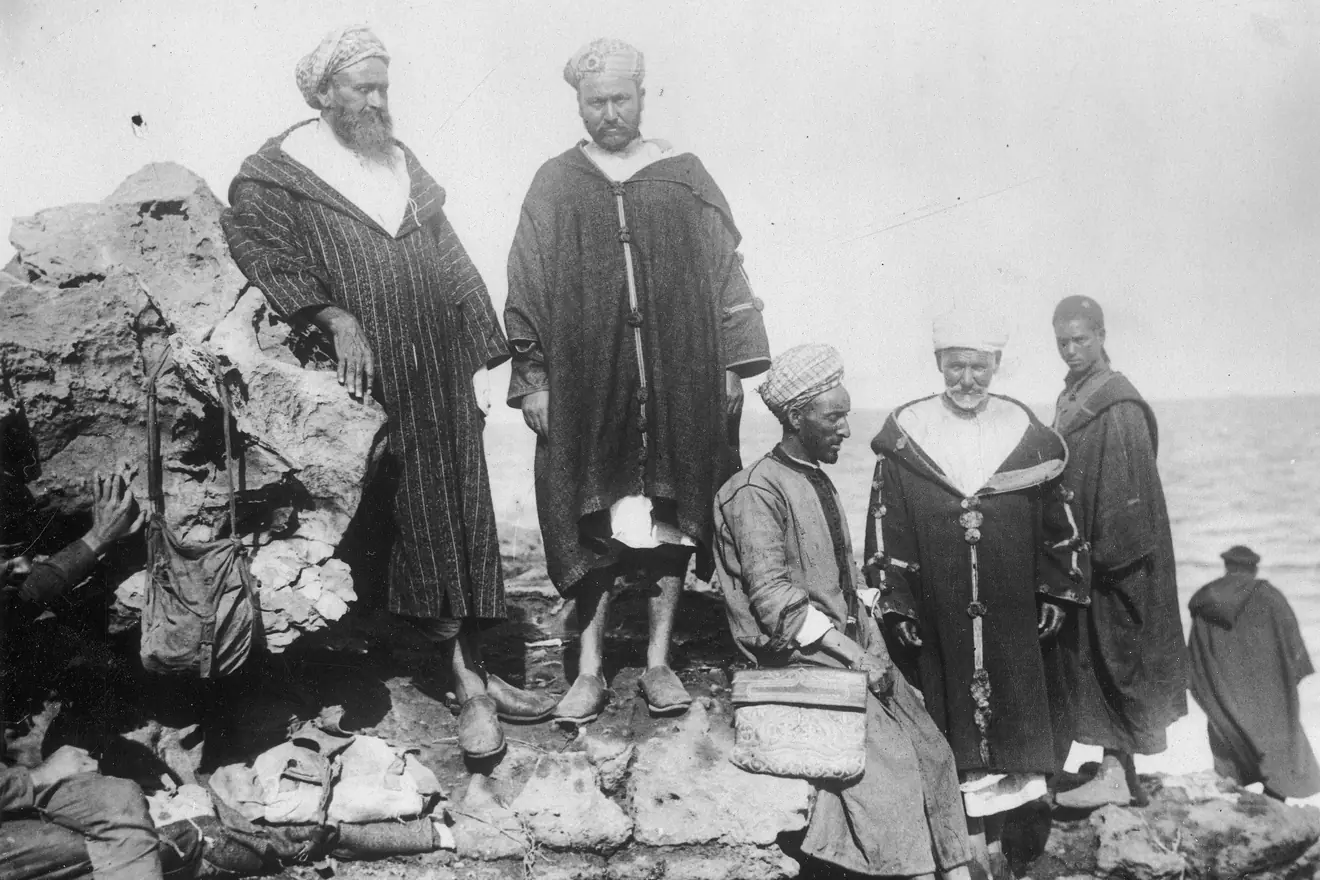
anuary 1961. In the midst of the Algerian war, Casablanca receives the most determined heads of state the continent can muster: Kwame Nkrumah of Ghana, Sekou Toure of Guinea, Modibo Keita of Mali, Gamal Abdel Nasser, who came from Egypt in person, and Ferhat Abbas, president of a provisional Algerian government that doesn’t yet govern any territory. In the corridors move a delegation from Ruanda-Urundi and an envoy of Lumumba’s Stanleyville government.
At the rostrum of the inaugural session, Mohammed V delivers the only speech. He proposes to the assembled leaders the ten points that will become the Casablanca Charter, and even an African Consultative Assembly. The charter sketches four permanent organs, among them a joint African high command, the skeleton of what will become, twenty-eight months later in Addis Ababa, the Organization of African Unity. Seven weeks after closing the conference he had built, the sovereign will pass away, thus leaving the continent this text by way of testament.
This dossier runs from that room of January 1961 to the signing ceremony of Freetown in July 2026, six decades of Moroccan engagement for Africa, whose contradictions and setbacks we will not pass over, every fact coming with its source. We will see first the sanctuary offered to the Algerian revolution and to the liberation movements, then the three weeks of March 1962 during which Nelson Mandela trained on Moroccan soil, the chair left empty at the African Union and the return of 2017, the imprint of the banks, the ports and the pipeline, and finally that deeper bond (spiritual, learned, human) which precedes and outlasts geopolitics.
The arsenal of decolonization
The Algerian sanctuary
You should know that Moroccan independence in 1956 preceded Algeria’s by six years, and that the young kingdom placed that head start at its neighbor’s service. The historian Benjamin Badier, biographer of Mohammed V, has established its scale. The command of Wilaya V was installed near Oujda, camps operated notably at Nador, Khemisset, Larache and Tetouan, and a line of frontier bases ran from Oujda to Figuig through Boubker, Berguent, Tendrara and Bou Arfa. By late 1960, close to five thousand Algerian fighters were organizing, arming and healing on Moroccan soil.
On October 22, 1956, French aviation will intercept a Moroccan airliner carrying from Rabat to Tunis five leaders of the FLN (Ahmed Ben Bella among them), who had just been received by Mohammed V. A civilian aircraft diverted on the orders of the French authorities, the affair will be felt in Rabat as an affront to the kingdom’s sovereignty as much as a blow against the Algerian revolution. It’ll seal the commitment of the sultan become king. Indeed, Badier writes that Mohammed V “was never more committed to the Algerian cause than in the final weeks of his reign.”
It was in Tangier, moreover, that in April 1958 the Istiqlal, the Tunisian Neo-Destour and the FLN had convened the conference that dreamed of a Maghreb of peoples, united in the anticolonial struggle.
However, the French services, who watched everything, didn’t detect any direct governmental funding of the FLN by Rabat, and the kingdom, careful to spare Paris, apologized in advance before recognizing, in September 1958, the provisional Algerian government. Moroccan support was first of all territorial and political, that of a sanctuary, of strategic depth and of a voice at the United Nations.
Rabat, crossroads of liberations

As for the rest of the continent, Rabat will become within a few years what Mandela will call “the crossroads of virtually every liberation movement” in Africa. In August 1960, Mohammed V will receive Patrice Lumumba, prime minister of a Congo independent for only a few weeks, and decorate him with the grand cordon of the Order of the Throne. The historian Maati Monjib records the public promise the sovereign then made to his guest:
“Morocco stands at your side and places at your disposal the lessons of its experience, as well as its diplomatic, military and technical means of action, to help you overcome your present difficulties. You are on the side of right and of justice, which always triumph in the end.”
— Mohammed V to Patrice Lumumba, Rabat, August 1960 (as recorded by Maati Monjib, Zamane; our translation)
Morocco will be among the very first to answer the United Nations’ call for the Congo, and its blue helmets will be among the first deployed in the ONUC operation. General Ben Hammou Kettani, the highest-ranking Moroccan of the former French army, will be asked by Lumumba himself to reorganize the Congolese army, and will become the mentor and protector of a young colonel named Joseph Mobutu. The American diplomatic archives preserve the trace of his influence, and the historian Fatima Boussaid concludes that in September 1960, Morocco was, through its general, “the inspiration, if not the architect” of Mobutu’s first coup.
Four months later Lumumba was dead, and Morocco was withdrawing its troops from the Congo pursuant to a resolution voted in Casablanca itself. Thus, the kingdom will have served the birth of the independent Congo and, much against its king’s designs, the trajectory of the man who would confiscate it.

In April 1961, a few weeks after the conference, Amilcar Cabral, Mario Pinto de Andrade and Marcelino dos Santos will found in Casablanca the CONCP, the conference federating the liberation movements of the Portuguese colonies. These were the PAIGC of Guinea-Bissau, the MPLA of Angola and the future FRELIMO of Mozambique, and the general secretariat will sit in Rabat. The guerrillas that would bring down Europe’s oldest colonial empire therefore had, for years, their continental address in Morocco.
The price of Casablanca
Should the legend be gilded for all that? The conference of January 1961 also had its price. The same session that promised unconditional support to fighting Algeria voted a resolution declaring Mauritania a “fictitious state.” It also approved “any action taken by Morocco in Mauritania to recover its legitimate rights.” The journalist Margaret Roberts, covering the conference, noted that outside the Moroccan delegation enthusiasm for this cause was thin.
Likewise, Morocco and Libya, which then hosted Western bases, had the charter’s clause on foreign military bases softened, against the harder line of Guinea, Mali and Egypt. The pan-Africanism of Casablanca also served the Moroccan interests of the moment, and the kingdom calculated in it as its peers did.
The balance sheet counts a founding charter, a joint command sketched out and a capital offered to the liberators, which few African capitals could claim.
The empty chair and the return
Addis Ababa, 1963
The Casablanca group and the rival Monrovia group will end up converging. In May 1963, in Addis Ababa, the independent states of Africa will found the Organization of African Unity, whose charter owed much, in architecture as in spirit, to the Casablanca text.
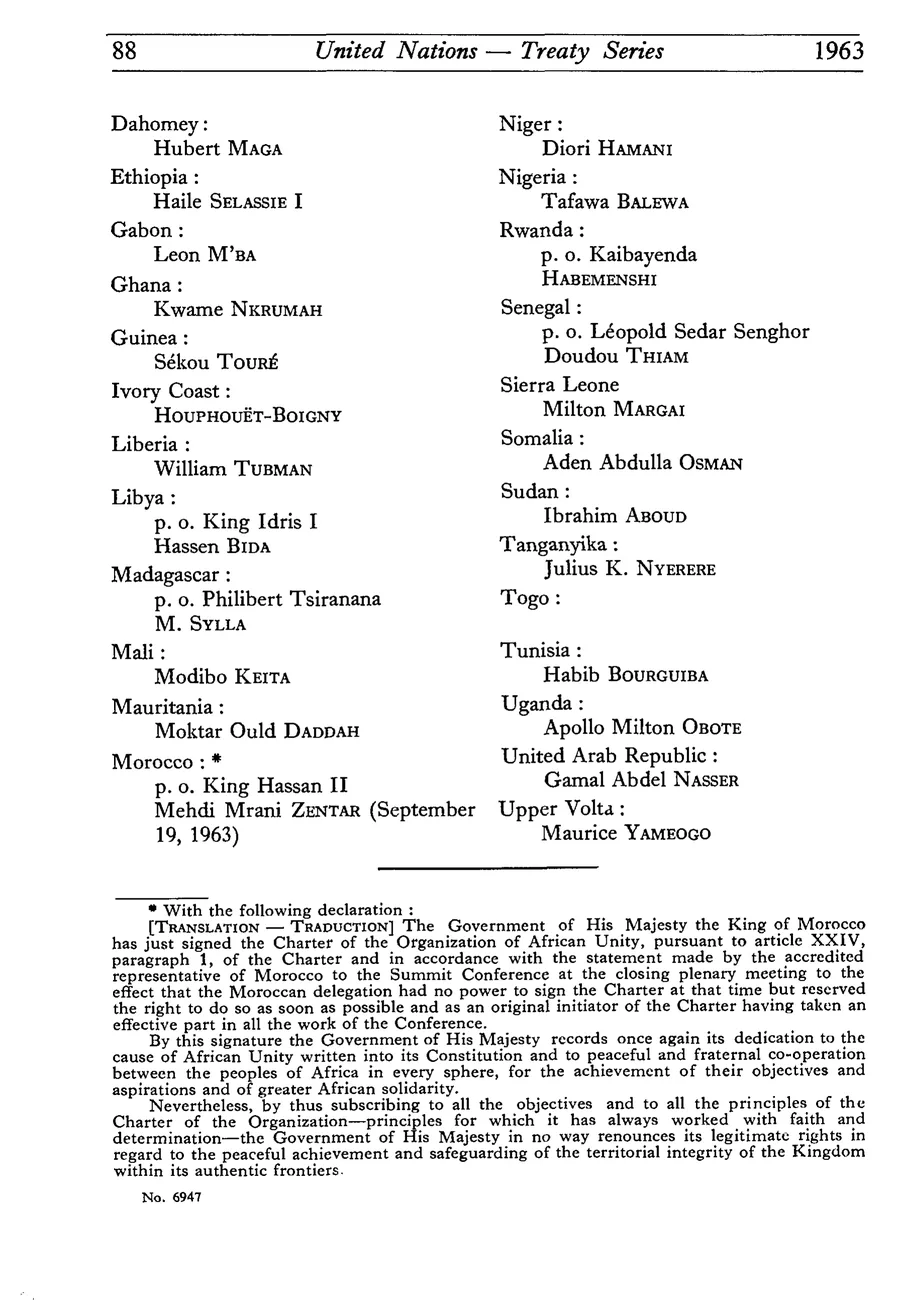
A stubborn legend holds that Morocco sulked at this birth, which the archives contradict. In fact, the United Nations Treaty Series shows that the kingdom took part in all the work of the founding conference. Its delegation had “no power to sign the Charter there and then,” and the kingdom signed it on September 19, 1963, “as a founding member,” in the very words of its annexed declaration. Morocco ranks among the co-founders of the OAU.
1984, the empty chair
The break will come in three stages, starting in February 1982, when OAU secretary-general Edem Kodjo seated the “Sahrawi Arab Democratic Republic” on the backing of twenty-six members out of fifty. Following this decision, the organization will fracture to the point that two summits convened in Tripoli will collapse for want of a quorum. The June 1983 summit will be held only because the Sahrawi leaders agreed to withdraw from it “voluntarily” (the summit’s resolution thanks them for it in black and white).
The reprieve will last seventeen months, until November 6, 1984, when Hassan II announced in Fes the exit six days in advance, in his Green March address. Were Morocco to be asked for more than it had conceded, “it will yield its place to whoever succeeds it, wishing the OAU long life and success.”
On November 12, at the 20th Addis Ababa summit, the Sahrawi delegation will take its seat. Royal counselor Ahmed Reda Guedira will then read out the King’s message (a text of fidelity). Morocco will retain these words from it: “African is Morocco, and African it shall remain,” and “as a founding member of African unity, Morocco cannot be its gravedigger.” One year later to the day, Hassan II will state his conviction:
“The OAU has repudiated not its charter but, far more, the fundamental law it has violated.”
— Hassan II, address of November 6, 1985 (our translation)
For thirty-two years, the kingdom’s African policy will be made without the summits. Deprived of the chamber, Morocco will thus invest the ground, and the royal tours, the bilateral agreements, the banks and the airline routes will do during the absence what multilateral diplomacy could no longer do.
The road home
The return will be prepared in the open, step by step, and will begin with a quotation. On July 17, 2016, in a message addressed to the Kigali summit, Mohammed VI will take up word for word the phrase with which his father had accompanied the departure, and turn its meaning around:
“Our friends have long been asking us to come back, so that Morocco may resume its natural place within its institutional family. That moment has now come. On reflection, it became clear to us that when a body is sick, it is better treated from the inside than from the outside. The age of ideologies is over. Our peoples need concrete results and tangible action.”
— Mohammed VI, message to the 27th African Union summit, Kigali, July 17, 2016 (our translation)
“Morocco, which left the OAU, never left Africa,” the sovereign added: “it only left an institution.”
A few months later, on November 6, 2016, the Green March address will be delivered, for the first time in history, outside the kingdom, from Dakar, as if to match the gesture to the word.
“It is beautiful, the day one returns home”

It is in Addis Ababa, at the 28th summit of the African Union, that everything will play out. On January 30, 2017, the Assembly admitted the kingdom “in conformity” with the Constitutive Act, in a decision that invokes the “pan-African values of the Founders.” According to the Union’s communique, thirty-nine states out of fifty-four had signified their support in writing. The next day, Mohammed VI will mount the rostrum, and the first words of his speech will travel the continent:
“It is beautiful, the day when one returns home, after too long an absence! It is beautiful, the day when one carries one’s heart toward the beloved home! Africa is My Continent, and My home.”
— Mohammed VI, address to the 28th African Union summit, Addis Ababa, January 31, 2017 (MAP transcript; our translation)
The sovereign also gave his figures in it, forty-six royal visits to twenty-five African countries and nine hundred and forty-nine agreements concluded with African countries since 2000, against five hundred and fifteen between 1956 and 1999, “nearly double.”
He drew a severe picture of the Maghreb, whose “UMA flame has gone out” while intra-Maghreb trade stagnates below 3% where ECOWAS reaches 10%. Since Maghreb integration is dying, the speech said in substance, Morocco’s future is written with West Africa and with the whole continent. In 2026, foreign minister Nasser Bourita updated the count to fifty-three royal visits to more than thirty countries and close to one thousand eight hundred bilateral agreements, of which one thousand four hundred were concluded under the reign of Mohammed VI.
In the organs of the Union
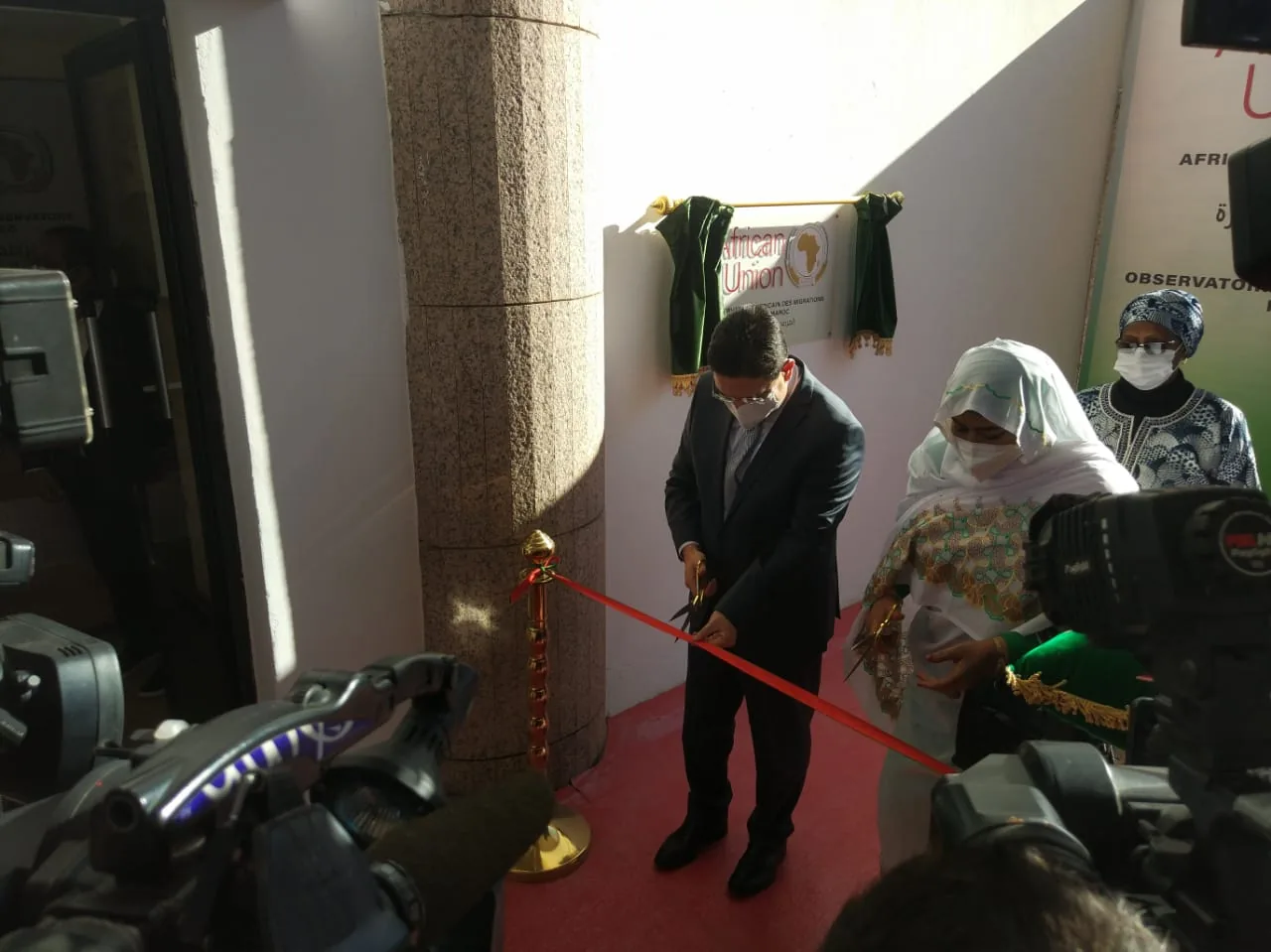
Since 2017, the kingdom has reinvested the Union’s organs one by one. Elected to the Peace and Security Council as early as 2018, re-elected for 2022-2025 and for 2026-2028, it was designated, in the person of the King, the African Union’s leader on the question of migration. The African Agenda on Migration, presented at the January 2018 summit, led to the creation of the African Migration Observatory, inaugurated in Rabat on December 18, 2020 (International Migrants Day), the first and to this day only institution of the African Union hosted by Morocco.
As early as July 2018, the Nouakchott summit moreover ruled that the Sahara question would henceforth be handled only at the level of heads of state and within the United Nations process. The “SADR” remains a full member of the Union, the clause has however held, and the subject has since disappeared from the Assembly’s decisions.
In February 2025, the Union formally commended Morocco’s support, “for the third time in a row,” for the training of African election observers. However, the same year, the candidacy of Latifa Akharbach for the deputy chairmanship of the Commission (the first Moroccan bid for an elective Commission post) was defeated by Algeria’s Selma Malika Haddadi after six rounds of voting.
Banks, ports, pipeline: the other integration
The stock and the flow
What does economic Morocco weigh in Africa? The standard formula (“second African investor on the continent, first in West Africa”) comes from the African Development Bank and corresponds to the data of 2021, the year in which 808 million dollars, or 43% of all Moroccan direct investment abroad, took the direction of the continent.
Recent flows have changed course since, and in 2024, of 27 billion dirhams of Moroccan investment abroad (nearly four times the 2015 level), half went to France, with Mali and Ivory Coast trailing far behind. The African stock, massive and old, nonetheless makes Morocco’s weight on the continent, even if the recent flow also looks to Europe, and it can be read in three networks.
The banks
Bank Al-Maghrib counts Moroccan banking groups in twenty-seven African countries, through forty-five subsidiaries and four branches. Attijariwafa bank, present in fourteen African countries, serves more than twelve million clients, and its international retail banking accounts for a third of its net banking income. Bank of Africa covers fifteen countries, and Banque Centrale Populaire completed at the end of 2025 its acquisition of all of Atlantic Business International and its West African banks. When a merchant of Dakar, Abidjan or Libreville pushes open the door of his bank, he thus often enters, without always knowing it, an institution whose head office looks out on the Atlantic from Casablanca.
The networks

Besides this, there is telecommunications, where Maroc Telecom counts close to seventy-seven million customers, of whom some fifty-four million are mobile subscribers of its Moov Africa subsidiaries in ten countries. In the air, Royal Air Maroc serves twenty-nine African destinations from its Casablanca hub, designed to link Africa to Europe and the Americas in a single stopover. The airline deploys on them for the summer of 2026 more than one million eight hundred thousand seats, up by a good third.
At sea, Tanger Med handled in 2025 more than eleven million containers and one hundred and sixty-one million metric tons of cargo. According to the 2025 Lloyd’s List ranking, based on 2024 volumes, it is the first container port of Africa and the seventeenth in the world. The World Bank’s performance index, more severe, ranks it fifth worldwide but second in Africa, behind Port Said.
As for OCP, holder of the world’s largest phosphate reserves, it has made Africa a strategic priority. Its subsidiary OCP Africa is present in sixteen countries, and four million metric tons of fertilizer were dedicated to the continent as early as 2023, in the service of African food sovereignty.
The pipeline and the Atlantic

On July 19, 2026, in Freetown, the heads of state of ECOWAS signed the intergovernmental agreement of the African Atlantic gas pipeline. The line is to run some six thousand eight hundred kilometers along thirteen coastal countries, from the Niger delta to the European network via Morocco, for thirty billion cubic meters a year at term and twenty-five billion dollars of investment. The agreement provides for a project company in Casablanca and a pipeline authority in Abuja, Morocco’s ONHYM and Nigeria’s NNPC at the controls.
The calendar announces first gas around 2031 through the northern segment, fed by the Senegalese-Mauritanian fields, but the final investment decision, prudence obliging, remains to be taken.
This pipe belongs to a larger design, the Atlantic Initiative launched by the King on November 6, 2023 and given form at the Marrakech ministerial meeting of December 23 that year. The Initiative offers the landlocked states of the Sahel (Mali, Burkina Faso, Niger, Chad) access to the ocean through the port of Dakhla Atlantique, whose construction passed 60% completion in 2026 for a commissioning expected around 2028-2029. Critical voices, such as the researcher Jean-Yves Moisseron, read in it also a consolidation of the Moroccan character of the Sahara through economics, which the kingdom hardly hides.
However, Morocco is still not a member of ECOWAS. Its membership application, transmitted on February 24, 2017, will be “supported in principle” by the Monrovia summit in June of the same year. Six months later, the Abuja summit will observe that the organization’s texts simply did not provide for the admission of a third state. Since December 2017 the file has not appeared on the agenda again, though it was neither withdrawn nor rejected.
Mali, Burkina Faso and Niger have meanwhile left ECOWAS, in January 2025, and now walk with Rabat in the Atlantic Initiative. ECOWAS as a bloc, for its part, endorsed, at Freetown, Morocco’s pipeline (which the kingdom, not being a member, will sign on its own).
The depth of the bond
The faith

Long before the bankers, there were the saints. Since 1815, the zawiya of Sidi Ahmed Tijani in Fes has been, after the Holy Places, the second pilgrimage of the countless disciples of the Tijaniyya. Born in the Algerian south, this Sufi path will come to settle in Fes, where its founder rests. It will then be transmitted to West Africa by a chain of masters running from Muhammad al-Hafiz and El Hadj Omar Tall to the famous Sheikh Ibrahim Niass, from Mauritania and Senegal to Nigeria.
It is this heritage the kingdom has institutionalized, Mohammed VI thus inaugurating in Rabat, in March 2015, the Mohammed VI Institute for the training of imams, morchidines and morchidates. According to the minister of Habous Ahmed Toufiq, the institute will train between 2015 and 2022 two thousand seven hundred and ninety-eight students from nine African countries.
The same year saw the creation, by royal dahir, of the Mohammed VI Foundation of African Oulema, seated by the Qaraouiyine of Fes, the oldest university in the world still in operation, which thus becomes again the African address it was for centuries. Morocco offers there an Islam of the middle way rooted in a shared heritage, what is called its spiritual diplomacy.
The knowledge
The Moroccan university is the continent’s other great gateway, and the Moroccan Agency for International Cooperation counted for 2019-2020 some twelve thousand five hundred African students of forty-seven nationalities in the kingdom’s public institutions, the overwhelming majority of them on Moroccan scholarships. In cumulative terms, the Royal Institute for Strategic Studies speaks of more than twenty-five thousand African students trained, and more than five thousand public-sector executives from thirty countries.
Doctors, engineers or magistrates, a notable share of the continent’s francophone elites passed through Rabat, Fes or Marrakech, and keeps the attachments one may guess. Jeune Afrique goes as far as describing the kingdom as “the leading center of excellence for the training of sub-Saharan medical and administrative elites,” its medical faculties and university hospitals receiving in particular, every year, hundreds of African students and residents on AMCI scholarships.
The hospitality

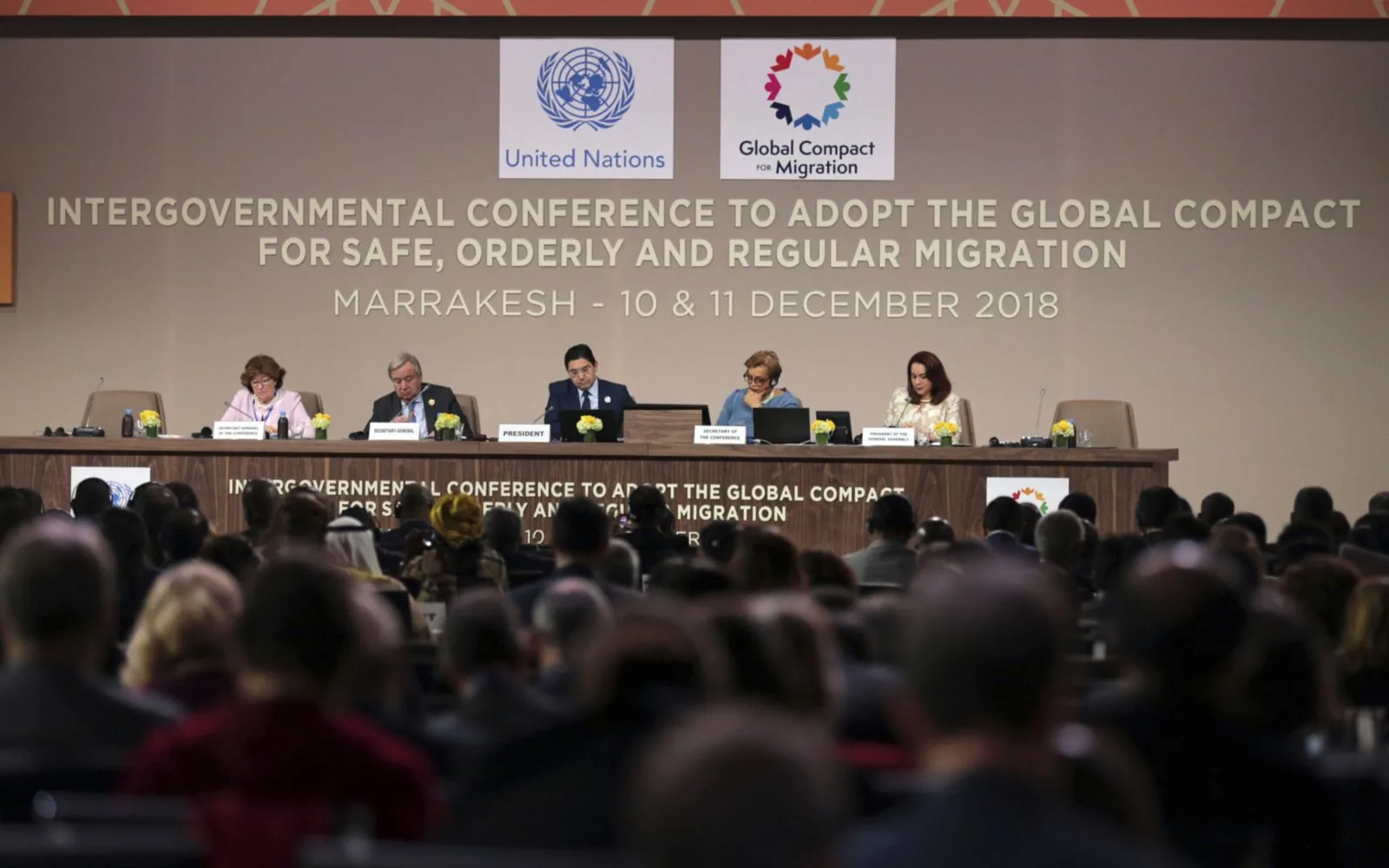
In 2013, the kingdom, which had until then thought of itself as a land of transit, will own up to being a land of welcome, a doctrinal reversal rare on the continent. Two exceptional regularization campaigns, in 2014 and in 2016-2017, will regularize in all more than fifty thousand people, most of them sub-Saharan (official tallies vary between administrations). It was in Marrakech, moreover, that the world came in December 2018 to adopt the Global Compact for Migration, the same week the kingdom signed with the African Union the host agreement of the Rabat Observatory. For a moment, the imperial city was the migration capital of the planet.
On the humanitarian side, the field hospital deployed in Conakry from February to May 2014 delivered more than twenty-three thousand medical procedures. In June 2020, at the height of the pandemic, an airlift of twenty-four Royal Air Maroc aircraft carried Moroccan medical aid to fifteen African countries. The magazine Zamane recalled as early as 2011, however, that sub-Saharan students arriving in Morocco sometimes leave it disappointed.
A doctrine
What is left of the Casablanca room of January 1961? A conviction, formulated by Mohammed VI in Abidjan in February 2014, which serves as doctrine:
“Africa is a great continent, in its living forces, its resources and its potentialities. It must take charge of itself; it is no longer a colonized continent. That is why Africa must trust Africa.”
— Mohammed VI, address to the Moroccan-Ivorian Economic Forum, Abidjan, February 24, 2014 (our translation)
The empty chair and the defeats in committee also belong to this record. Since a dying king gathered in his home the fathers of independence, Morocco has however kept on pleading, in deeds, that its destiny is written in Africa. The formula of Addis Ababa (“Africa is My Continent, and My home”) thus described a policy more than half a century old. The next milestone, around 2031, will be first gas from the Atlantic pipeline.
- Casablanca Charter and resolutions of the African Conference of Casablanca (4-7 January 1961), contemporary booklet, Cairo, 1961 (Tchiweka de documentação collection, Luanda).
- Benjamin Badier, Mohammed V, dernier sultan et premier roi du Maroc, Perrin, 2025.
- Margaret Roberts, “The Casablanca Conference”, Africa South, 1961.
- Fatima Boussaid, “Morocco and the Congo crisis”, The International History Review, vol. 43, 2021.
- Foreign Relations of the United States (FRUS), 1958-1960, vol. XIV, Africa: dispatches of 9 and 27 September 1960.
- Maâti Monjib, “La conférence de Casablanca”, Zamane, 7 May 2020.
- Garth Benneyworth, “Armed and Trained: Nelson Mandela's 1962 Military Mission as Commander in Chief of Umkhonto we Sizwe and Provenance for his Buried Makarov Pistol”, South African Historical Journal, vol. 63, no. 1, 2011.
- Nelson Mandela, Long Walk to Freedom, Little, Brown, 1994.
- Nelson Mandela, “Statement from the Dock”, Rivonia trial, 20 April 1964 (ANC archives).
- Nelson Mandela Foundation, “Nelson Mandela's military training”, correction of 12 November 2012.
- David James Smith, Young Mandela, 2010.
- “Dr Abdelkrim Khatib, premier ministre des Affaires africaines”, TelQuel, 27 October 2017.
- ANC photographic archives, state visit of Nelson Mandela to Rabat, 2 November 1994.
- Statement by the Umkhonto we Sizwe (MK) party, received in Rabat, 15 July 2025.
- Address by H.M. King Mohammed VI to the 28th African Union Summit, Addis Ababa, 31 January 2017 (MAP transcript).
- Address by H.M. King Mohammed VI to the Moroccan-Ivorian Economic Forum, Abidjan, 24 February 2014 (official portal of the Kingdom, maroc.ma).
- African Union, Assembly decisions: Assembly/AU/Dec.639(XXVIII), 662(XXIX), 674(XXX), 693(XXXI), 695(XXXI), 750/758(XXXIII), 819(XXXV), 823(XXXV), 916(XXXVIII), 961(XXXIX); OAU, AHG/Res.104(XIX); AU communique of 2 February 2017 (au.int).
- United Nations Treaty Series, vol. 479, no. 6947: Charter of the Organisation of African Unity, signature block and annexed declaration of Morocco (19 September 1963).
- Addresses by H.M. King Hassan II of 6 November 1984 and 6 November 1985 (royal speeches archive, IRES).
- Message from H.M. King Mohammed VI to the 27th African Union Summit, Kigali, 17 July 2016; Green March address, Dakar, 6 November 2016 (maroc.ma).
- Foreign Relations of the United States, 1981-1988, vol. XXIV, doc. 423 (Addis Ababa telegram, November 1984).
- ECOWAS, final communique of the 51st ordinary session of the Authority of Heads of State and Government, Monrovia, 4 June 2017, §61.
- Statement by Nasser Bourita, Africa Day, Rabat, 26 May 2026.
- Bank Al-Maghrib, census of Moroccan banking presence in Africa, cited in Attijariwafa bank, Rapport financier 2025.
- Tanger Med Port Authority, “Port Activity Report in 2025”, press release of 2 February 2026; Lloyd's List, One Hundred Container Ports 2025.
- US Department of State, Investment Climate Statement: Morocco, 2022 (Office des Changes/AfDB data, 2021); Office des Changes, Moroccan direct investment abroad series, 2015-2024.
- ONHYM and NNPC Ltd, joint communique on the intergovernmental agreement of the African Atlantic Gas Pipeline, Freetown, 19 July 2026; Médias24, “Gazoduc Nigeria-Maroc: qui paiera et quand le gaz arrivera”, 23 July 2026.
- France 24, “Désenclaver le Sahel: le mégaprojet du Maroc”, 1 May 2025.
- Ministry of Habous and Islamic Affairs, statement by Minister Ahmed Toufiq before the House of Councillors, 8 February 2023 (via Hespress).
- Agence marocaine de coopération internationale (AMCI), 2019-2020 data; Institut royal des études stratégiques (IRES), “Le Maroc en Afrique”, 2019.
- Ministry of Foreign Affairs, communique on medical aid to African countries, June 2020 (via Hespress Arabic, 14 June 2020).
- “Maroc-Afrique: une histoire occultée”, dossier, Zamane, December 2011.
- Royal Air Maroc, summer 2026 programme (press release).
- Maroc Telecom, 2025 annual results.
- OCP Africa, presence data (ocpafrica.com); OCP Group, communique on the 4 million tonnes of fertilizer dedicated to Africa, December 2022.
- Pan African Medical Journal, report on the Moroccan field hospital in Conakry, 2014.
- CNDH and Ministry of the Interior, reports on the exceptional regularization campaigns, 2014 and 2016-2017.