t was a little after half past three in the morning on Thursday, September 24, when Interior Minister Abdelouafi Laftit read the provisional results of the previous day’s vote to the microphones of the public broadcasters.
The Authenticity and Modernity Party came first with ninety-seven seats. The National Rally of Independents, which had led the government since 2021, followed with sixty-six, one seat ahead of Istiqlal on sixty-five. The Justice and Development Party, written off five years ago, took fifty-four.
These numbers do not yet name a head of government or a majority. They open a sequence the Constitution lays out step by step, and one that can be followed without any knowledge of parliamentary jargon.
This dossier takes it in order: what the ballot boxes said, who the PAM is now that it is set to lead the government, what it promises and who it might govern with, who the other forces in the House are, why no party governs alone, and how a government is born in Morocco. It will be updated as each step is taken.
What the ballot boxes said
The House of Representatives, the lower house of Parliament, the one that votes laws and grants or withholds its confidence in the government, has three hundred and ninety-five seats. Governing takes at least one hundred and ninety-eight of them, half plus one: the absolute majority. No party comes close. The PAM, in first place, holds barely a quarter.
Behind the top four come the Popular Movement (twenty-nine seats), the Socialist Union of Popular Forces (twenty-six), the Party of Progress and Socialism (nineteen) and the Constitutional Union (seventeen).
Six small formations share the remaining twenty-two seats, including eight for the Democratic and Social Movement and eight for the Left Alliance. Fourteen formations in all will sit in the new House.
Winners and losers
The most striking swing is the PJD’s. In 2021 the Islamist party, which had led two successive governments, fell from one hundred and twenty-five seats to thirteen; it now returns with fifty-four, four times as many.
The PAM gains ten seats. The RNI loses thirty-six and Istiqlal sixteen: the PAM’s two partners in the outgoing government fall back sharply while the third moves forward.
Only one seat separates the RNI from Istiqlal, and Medias24 warns that this provisional order could still flip.
The number of votes won by each party has not yet been published. Only seats are known at this stage; the detailed results will come with the final figures.
Six voters in ten stayed home
Fifteen million eight hundred and one thousand one hundred and sixty-two Moroccans were on the electoral rolls. Nearly six million voted, or 38.08% according to the minister’s statement.
The figure announced on Wednesday evening as polling stations closed, 38.02%, was revised up slightly overnight, as it was in 2021. It is the lowest turnout since 2007, when it stood at 37%, and far from the 50.35% of 2021, when one registered voter in two turned out.
The gaps between regions are wide. According to the minister, turnout reached 77% in the Laayoune-Sakia El Hamra region and 61% in Dakhla-Oued Eddahab, while the Casablanca-Settat regional constituency stopped at 34.60%.
Update of September 26: the results are final
In a communique issued on Thursday, September 25, the Interior Minister announced that the final results of the September 23 vote match exactly the general provisional results released on the night after polling: the distribution of the three hundred and ninety-five seats in the House of Representatives is unchanged, with the PAM first on ninety-seven.
The provincial and regional recount commissions, chaired by judges, completed the counting of votes and the proclamation of results, drew up the official minutes and lodged a copy with the Constitutional Court.
Under Article 86 of the organic law on the House of Representatives, every candidate may consult those minutes with the competent administrative authority for eight full days from the date they were lodged.
Update of September 29: Fatima Ezzahra El Mansouri appointed head of government
King Mohammed VI received Fatima Ezzahra El Mansouri, coordinator of the collegial leadership of the Authenticity and Modernity Party, at the Royal Palace in Rabat on Tuesday, September 29, and appointed her head of government, tasking her with forming the new government, the Ministry of the Royal Household, Protocol and Chancellery announced in a communique.
The appointment was made, the text states, “under Article 47 of the Constitution,” which provides that the King appoints the head of government from the party that came first in the elections to the House of Representatives.
The same article sets out what comes next: it is on the head of government’s proposal that the sovereign would appoint the members of the new team, which would then have to win the confidence of the House.
Update of September 30: first consultations with the RNI and Istiqlal
The day after her appointment, Fatima Ezzahra El Mansouri opened the consultations to form the new government on Wednesday, September 30, at the PAM’s headquarters in Rabat.
She first received a delegation from the National Rally of Independents led by its president, Mohamed Chaouki, with Rachid Talbi Alami and Mohamed Boussaid, then one from the Istiqlal Party, led by its secretary general, Nizar Baraka, with Mohamed Ould Errachid, Abdessamad Kayouh and Abdeljabbar Rachidi.
Abdellatif Ouahbi, Fouzi Lekjaa and Ahmed Akhchichine sat alongside the head of government designate.
After the meeting, Nizar Baraka said that Istiqlal’s National Council would examine the party’s participation in the new government, LesEco.ma and Medias24 report, the latter adding that the RNI will also consult internally before deciding.
Update of September 30, evening: the MP, USFP and PPS received in turn
The first day of consultations continued in the afternoon with the Popular Movement, whose delegation was led by its secretary general, Mohamed Ouzzine, then with the Socialist Union of Popular Forces, led by its first secretary, Driss Lachgar, before the Party of Progress and Socialism was received in the evening, Le360, Hespress and Barlamane report.
On leaving, the PPS secretary general, Nabil Benabdallah, said his party had not yet settled its position on joining the government: “We are continuing our internal debate in order to decide in the coming days,” he said, according to Le360.
He noted points of convergence with the PAM, notably on citizens’ social situation, and called for “restoring trust,” Hespress and Barlamane report.
Update of October 13: Ahmed Touizi elected speaker of the House of Representatives
Ahmed Touizi, a member of the political bureau of the Authenticity and Modernity Party, was elected speaker of the House of Representatives on October 13, under Article 62 of the Constitution, La Vie eco, Barlamane and Medias24 report.
He received two hundred and twenty votes out of three hundred and sixty-nine ballots, against fifty-nine for Driss El Azami El Idrissi, head of the Justice and Development Party group, with ninety ballots declared void, according to La Vie eco and Barlamane. He succeeds Rachid Talbi Alami in the chair of the lower house.
Update of October 16: the El Mansouri government appointed at the Royal Palace in Rabat
King Mohammed VI presided on October 16, at the Royal Palace in Rabat, over the appointment ceremony of the members of the new government led by Fatima Ezzahra El Mansouri, who took their oath before the sovereign, Infomediaire, LesEco and LNT report.
The team has thirty-two members: the head of government, nineteen ministers, the secretary general of the government, Hassan Tariq, and eleven ministers delegate.
Abdelouafi Laftit stays at the Interior, according to LNT. Nasser Bourita is appointed to Foreign Affairs, African Cooperation and Moroccans Living Abroad, Abdellatif Ouahbi to Justice and Ahmed Toufiq to Habous and Islamic Affairs.
Fouzi Lekjaa takes the Economy, Finance and Public Performance, Nizar Baraka Infrastructure, Water and Forests, Ryad Mezzour Industry, Trade, Investment and Economic Inclusion, and Charafat Afailal Energy, Mines and Sustainable Development.
A ministry of Artificial Intelligence, Digital Transformation and Administrative Reform goes to Ahmed Rahhou, and Samir Belfkih, minister of National Territorial Planning, Urban Planning, Housing and City Policy, becomes government spokesman.
In the social departments, Nabil Benabdallah receives National Education, Preschool, Vocational Training and Qualification, Youns Bjijou Health and Social Protection, Azzeddine El Midaoui Higher Education, Scientific Research and Innovation, Abderrahim Chahid Employment and Social Dialogue, and Najwa Koukouss Family, Social Development and Equality.
Khalid Hatimy is appointed to Agriculture, Maritime Fisheries and Food Sovereignty, Abdessamad Kayouh to Transport and Logistics, Mohamed Mehdi Bensaid to Youth, Culture and Sports, and Jalal Charaf to Tourism, Handicrafts and the Social Economy.
Among the ministers delegate, Abdeltif Loudyi is in charge of the Administration of National Defense and Kouloub Faitah of Relations with Parliament and Civil Society, both attached to the head of government.
Update of October 22: the House of Representatives gives its confidence to the El Mansouri government
The House of Representatives approved on Thursday, October 22, at the end of a sitting that opened at ten in the morning and ran into the evening, the program Fatima Ezzahra El Mansouri had presented to it earlier in the week.
The text won two hundred and four votes for and one hundred and twenty-seven against, out of three hundred and thirty-one votes cast, Medias24 and LNT report.
Article 88 of the Constitution makes the government’s investiture conditional on the approval of its program by an absolute majority of the House’s members, that is one hundred and ninety-eight votes out of three hundred and ninety-five, LNT recalls.
The PAM, the party set to govern
In Morocco the party that comes first does not govern automatically, but it is from its ranks that the King chooses the head of government. Whatever coalition emerges, the next head of the executive will therefore come from the Authenticity and Modernity Party. It will be a first: the PAM has never led a government.
Where it comes from
The party was founded in 2008 around Fouad Ali El Himma and took a tractor as its emblem. It sits on the center right, with a liberal, modernizing message.
During the decade the PJD led the government, from 2011 to 2021, it was its main opponent: second in 2016 with one hundred and two seats, it sat in opposition.
In 2021, second again with eighty-seven seats, it joined the government alongside the RNI and Istiqlal. This time it has taken first place, something it had never done before.
Who runs it
The PAM has no secretary general. Since its February 2024 congress it has been run by a collegial leadership of three: Fatima Ezzahra El Mansouri, mayor of Marrakech and minister of territorial planning, who coordinates it, Mohamed Mehdi Bensaid and Fatima Saadi.
The day after the vote, El Mansouri said the model would not change unless the National Council, the party’s internal parliament, asked for it.
In July 2026 the PAM brought Fouzi Lekjaa, minister delegate for the budget and president of the Royal Moroccan Football Federation, into its political bureau, and he played a highly visible part in its campaign.
What it promises
The PAM’s program for 2027 to 2031 was first priced at three hundred and fifty billion dirhams over five years. Fouzi Lekjaa later raised the total to three hundred and ninety billion, after measures for education and health were added.
Its most concrete pledges concern purchasing power: a minimum pension of three thousand dirhams a month, and direct social aid raised to at least one thousand dirhams.
According to Medias24’s reading of the program, it also promises free electricity for bills under one hundred dirhams a month, an income tax cut to three brackets with the top rate lowered from 37% to 20%, and at least one million net new jobs over the term.
To pay for it, the party is counting first on growth: it forecasts 5% a year, which would lift state revenue, while holding the budget deficit around 3%. This is still the program of a party that holds a quarter of the seats. How much of it survives will depend on the partners it has to govern with.
Who might lead the government
At a press conference in Rabat on Thursday, September 24, El Mansouri said the appointment belongs to the King alone, and was careful not to present herself as the natural candidate. She named other possibilities herself, Medias24 reports:
“If His Majesty does me the honor of appointing me, I will of course accept, but if he prefers another member of our party such as Fouzi Lekjaa, Mehdi Bensaid or Samir Belfkih, I will abide by his decision in the interest of our country.”
If the choice fell on her, Fatima Ezzahra El Mansouri would become the first woman to lead a Moroccan government.
With whom
During the campaign the PAM’s leadership had said it wanted no alliance with the RNI. Since its victory the tone has changed. “There is no party we refuse to sit down at the same table with,” El Mansouri said, adding that there is “no red line.”
The decision on alliances will rest with the party’s National Council, and programs, she said, will be the basis for it.
Aziz Akhannouch, whose RNI loses first place, congratulated the PAM and said he respected the voters’ choice. Abdelilah Benkirane, for his part, said the PJD could “in no case” join a government led by the PAM, a position his party’s governing bodies have yet to confirm.
The other forces in the House
The National Rally of Independents, founded in 1978 and symbolized by a dove, is a liberal, business-friendly party. It led the outgoing government under Aziz Akhannouch, who stepped down as party president in February 2026; Mohamed Chaouki succeeded him. Winner in 2021 with one hundred and two seats, it loses thirty-six.
Heir to the national movement and to the Independence Manifesto of January 11, 1944, the Istiqlal Party (Arabic for “independence”) is the oldest party in the race, and conservative in outlook. Its secretary general, Nizar Baraka, is minister of equipment and water in the outgoing government.
The Justice and Development Party, whose symbol is a lamp, is a conservative Islamist party. It led the government from 2011 to 2021 before collapsing in 2021. Under Abdelilah Benkirane, who returned to its helm after that defeat, it quadruples its seats and has placed itself in opposition from the outset.
The Popular Movement, rooted in the rural and Amazigh world, is led by Mohamed Ouzzine. Driss Lachgar’s USFP and Nabil Benabdallah’s PPS carry the historic left; all three sat in opposition. The Constitutional Union, led by Mohamed Joudar, is a liberal party.
No party founded since 2021 has entered the House: the only newcomer is the Left Alliance, an electoral coalition that puts the Unified Socialist Party and the Federation of the Democratic Left on a single ballot line, and which grows from about two seats to eight.
Why no one governs alone
A party that comes first by a wide margin in a constituency does not necessarily win more seats there than its rivals. It all comes down to the counting rule.
Morocco votes by proportional representation: in each constituency, seats are shared among the lists according to their votes. To work out how many votes a seat is “worth,” an electoral quotient is calculated.
Since 2021 that quotient has been the number of registered voters, not the number of people who actually voted, divided by the number of seats. Each list wins as many seats as its votes contain the quotient; the seats left over go to the lists with the largest “remainders.”
Take an imaginary constituency with one hundred thousand registered voters and five seats: the quotient is twenty thousand votes.
List A wins fifty-two thousand votes, which gives it two seats and leaves twelve thousand over. List B wins twenty-eight thousand: one seat, with eight thousand left.
List C wins fifteen thousand: no full seat, but a remainder of fifteen thousand. List D wins five thousand.
Two seats are still to be allocated, and they go to the largest remainders, C and then A. The result: three seats for A, one for B, one for C.
When six registered voters in ten stay home, the quotient becomes very high compared with the votes actually cast, and almost every seat is decided on remainders. The first-placed list in a constituency often takes just one seat, like the lists behind it.
The system scatters seats across many parties, and no minimum vote threshold keeps the smallest ones out: it was abolished in 2021. It is this mechanism, far more than the mood of the electorate, that makes coalitions inevitable.
Add one novelty for 2026. The House fills on two levels: three hundred and five seats are elected in ninety-two local constituencies, and ninety in twelve regional ones.
Under organic law 53.25, published in the Official Bulletin on January 29, 2026, the regional lists are made up exclusively of women, who remain free to stand on local lists as well.
The same law funds up to three quarters of campaign spending for lists of candidates under thirty-five, and punishes the spreading of false information meant to skew the vote with two to five years in prison.
How a government is born
What happens next is written in the 2011 Constitution. Its Article 47 sets the first rule:
“The King appoints the Head of Government from the political party that came first in the elections of the members of the House of Representatives, and on the basis of their results. On the proposal of the Head of Government, He appoints the members of the government.”
In practice, the King chooses a figure from the PAM and asks them to form a government. That person negotiates with other parties to gather at least one hundred and ninety-eight members, then proposes a list of ministers to the King.
Last comes the confidence vote under Article 88: the head of government presents a program to both houses sitting together, and the government takes office only once that program is approved by an absolute majority of the members of the House of Representatives, one hundred and ninety-eight votes. Challenges to the results follow their own path, before the Constitutional Court.
Quick, or very slow
The Constitution sets no deadline, and recent history offers both extremes.
In 2021 the vote took place on September 8; two days later the King received Aziz Akhannouch at the royal palace in Fes and appointed him head of government. The RNI, the PAM and Istiqlal reached an agreement on September 22, and the government was appointed on October 7: twenty-nine days in all.
In 2016 it took nearly six months. Abdelilah Benkirane, whose PJD had come first on October 7, was reappointed three days after the vote, but the talks stalled, in what the press called the “blockage.”
On March 15, 2017, the King would end his mission and, two days later, name Saadeddine El Othmani, from the same party, who would form his government on April 5.
The arithmetic
With its ninety-seven seats, the PAM needs one hundred and one more. The simplest answer renews the outgoing majority: the PAM, the RNI and Istiqlal hold two hundred and twenty-eight seats together, but in reverse order, with the PAM now in front.
That still requires the campaign rivalry to cool: on August 31, according to Le360, El Mansouri and Mohamed Mehdi Bensaid ruled the RNI out of the PAM’s alliances, before El Mansouri called it a personal position. “After our party’s victory, the question no longer arises,” she told Medias24 on September 24.
Without the RNI, the PAM and Istiqlal together hold one hundred and sixty-two seats: they would need at least thirty-six more members, which means one or more additional partners. The possible combinations are many, and none is settled.
What the ballot boxes do not decide
Not every ministry depends on the future coalition. The Interior, Foreign Affairs, Habous and Islamic Affairs, the administration of National Defense and the General Secretariat of the Government are traditionally entrusted to figures with no party affiliation, appointed by the King.
Whatever majority comes out of the talks, these portfolios will not change hands because of it.
What we do not know yet
The name of the next head of government is not known, nor the shape of the majority. Medias24 sums up the situation in one line:
“Only the King knows the answer.”
The House itself can still shift. Voters, candidates, walis and governors have thirty days after the results are proclaimed to challenge a member’s election before the Constitutional Court. In 2021 the court received sixty-two challenges, and annulled several elections.
In the meantime, Aziz Akhannouch’s government stays in place and handles current business. The calendar is tight: Parliament opens its autumn session on the second Friday of October, October 9, and the 2027 finance bill must reach it soon after.
Final results, with the vote counts, are expected in the coming days. This page will add them, then the appointment of the head of government, then the makeup of the team, as each of these acts is made public.
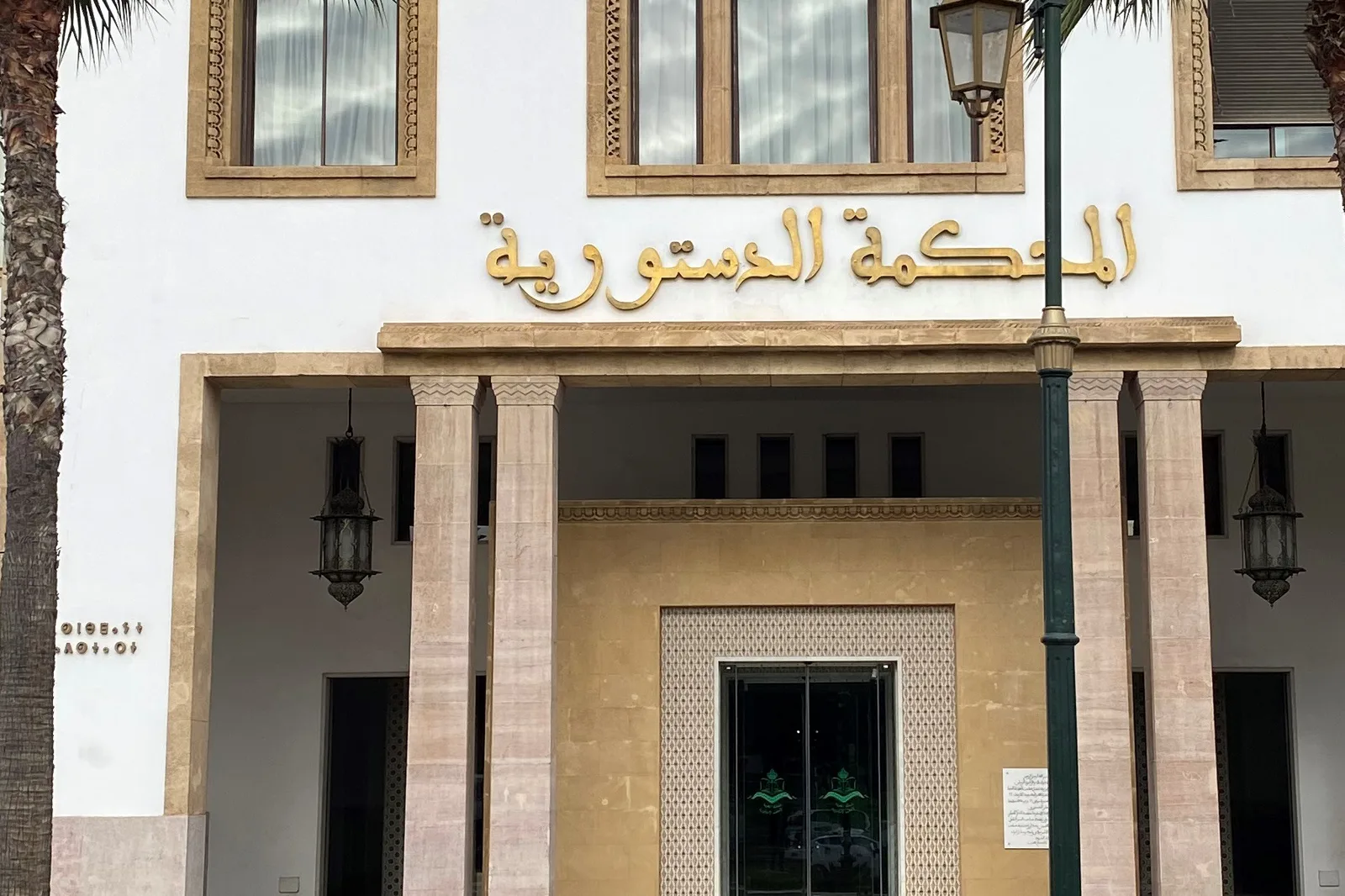
Photo: Boubloub, CC BY-SA 4.0. Charts: The Moorish Times.
Médias24 - Gouvernement El Mansouri : la Chambre des représentants vote la confiance
LNT - Le gouvernement El Mansouri investi par 204 voix
Infomédiaire - SM le Roi préside la cérémonie de nomination des membres du nouveau gouvernement
LesEco - Voici la composition du nouveau gouvernement au Maroc
LNT - Le Gouvernement El Mansouri officiellement formé
La Vie éco - Ahmed Touizi élu président de la Chambre des Représentants
Médias24 - Officiel. Ahmed Touizi élu président de la Chambre des représentants
Le360 - Gouvernement: le PPS n’a «pas encore tranché» sa participation, affirme Benabdallah
Hespress FR - Benabdallah : le PPS relève des convergences avec le PAM sans trancher sur son positionnement
Hespress FR - Formation du gouvernement : Lachgar reste discret après sa rencontre avec El Mansouri
LesEco.ma - Baraka : l’Istiqlal soumettra sa participation au gouvernement à son Conseil national
Barlamane - La chef du gouvernement désignée, Fatima-Ezzahra El Mansouri, reçoit la direction du parti de l’Istiqlal
Ministère de la Maison Royale, du Protocole et de la Chancellerie, via Aujourd’hui le Maroc - SM le Roi nomme Fatima Ezzahra El Mansouri Cheffe du gouvernement et la charge de former le nouveau gouvernement
LesEco.ma - Le roi Mohammed VI nomme Fatima Ezzahra El Mansouri cheffe du gouvernement
Ministère de l’Intérieur, via SNRT News - Communiqué du ministre de l’Intérieur: Les résultats définitifs des élections législatives correspondent parfaitement aux résultats généraux provisoires annoncés précédemment
Le Matin - Élections 2026: les résultats définitifs confirment le classement provisoire, avec le PAM en tête
Médias24 - Législatives 2026: les résultats définitifs confirment la victoire du PAM
Ministère de l’Intérieur, déclaration de M. Abdelouafi Laftit sur les résultats provisoires, 24 septembre 2026, reprise par la MAP.
LesEco.ma - Législatives 2026: le PAM en tête avec 97 sièges
Maroc Hebdo - Législatives 2026: Le PAM en tête avec 97 sièges, selon les résultats provisoires (Ministre de l’Intérieur)
Médias24 - Le PAM remporte les élections législatives 2026
Médias24 - PJD: après l’enthousiasme, la déception
Médias24 - Dans la circonscription régionale de Casablanca-Settat, un taux de participation de 34,60%
LesEco.ma - Législatives 2026: le taux de participation final s’établit à 38,02%
Le360 - Législatives: le PAM exclut toute alliance avec le RNI après le scrutin
Belpresse - Législatives 2026: El Mansouri clarifie sa position sur une alliance PAM-RNI
Médias24 - PAM: direction collégiale; Fatima Saadi remplace Aboulghali; Fouzi Lekjaa rejoint officiellement le PAM
Médias24 - FZ Mansouri: « Le PAM ne ferme la porte à aucun parti »
LesEco.ma - Après sa victoire, le PAM n’exclut aucun parti pour former la prochaine majorité
LesEco.ma - Future majorité: tous les jeux restent ouverts
Médias24 - Arrivé en tête des législatives, voici ce que vous a promis le PAM
LesEco.ma - Lekjaa à la CGEM: le PAM chiffre son programme à 350 milliards de DH; PAM: 390 milliards de DH sur cinq ans
Médias24 - Benkirane se prononce contre toute alliance avec le PAM; Aziz Akhannouch félicite le PAM; Après le scrutin, voici la saison des recours
Hespress - Mohamed Chaouki élu président du RNI
Médias24 - Le Roi Mohammed VI nomme Aziz Akhannouch chef du gouvernement (September 10, 2021)
France 24 - Morocco king names Saad-Eddine El Othmani new prime minister (March 17, 2017)
Constitution of the Kingdom of Morocco, 2011, Articles 47, 62, 65, 88 and 132. Article 47 and all quotations from French sources given in the magazine’s translation.
Décret n° 2.26.190 du 12 mars 2026 fixant la date d’élection des membres de la Chambre des représentants, Bulletin officiel n° 7491 du 16 mars 2026.
Loi organique n° 27-11 relative à la Chambre des représentants, as amended by organic law n° 04.21 (2021) and organic law n° 53.25, Bulletin officiel n° 7478 of January 29, 2026.
Charts: The Moorish Times, from the Interior Ministry’s provisional results and official turnout figures, 2002 to 2026.