ome, summer of 46 BCE. Caesar celebrates four triumphs in a few days, and the last, Plutarch tells us, is given for Africa, “over Juba the king.”
In the procession, between the spoils and the captives, an infant is carried along. He is the son of the defeated king, and he bears the same name.
Old Juba, king of Numidia and ally of Pompey, had taken his own life after the defeat at Thapsus, while the child, for his part, will grow up in the house of the victors. Plutarch will call him the most fortunate of captives, raised “from being a Barbarian and a Numidian” to the rank of the most learned historians of Greece.
This article sets its course for a king Morocco knows little about, although his kingdom covered the whole north of the country, from Tangier to Volubilis, and it will leave the court to follow the scholar. Three names he gave or brought into being, Canaria, Gaetulian purple and euphorbia, are still in use two thousand years after him.
Above, bronze bust of Juba II found at Volubilis, Rabat (photo Aemazy, CC0).
The most fortunate of captives
A prince raised in Italy
Cassius Dio sums up the prince’s youth in one sentence. Juba had been “brought up in Italy” and had campaigned at Octavian’s side.
After Actium, the future Augustus will give him “both the maid and the kingdom of his fathers,” the maid being Cleopatra Selene, daughter of Antony and Cleopatra, and the kingdom Numidia.

In 25 BCE Augustus changed the arrangement, and the same Dio reports that he exchanged Juba’s hereditary domain, most of whose inhabitants had been enrolled in the Roman state, for “portions of Gaetulia, and also the possessions of Bocchus and Bogud,” that is to say Mauretania. Strabo confirms that Augustus gave him this country “in addition to his father’s empire,” and Pliny the Elder will make Juba “the first to rule over both Mauretanias,” a king “more memorable still for the renown of his studies than for his reign.”
Caesarea and Volubilis
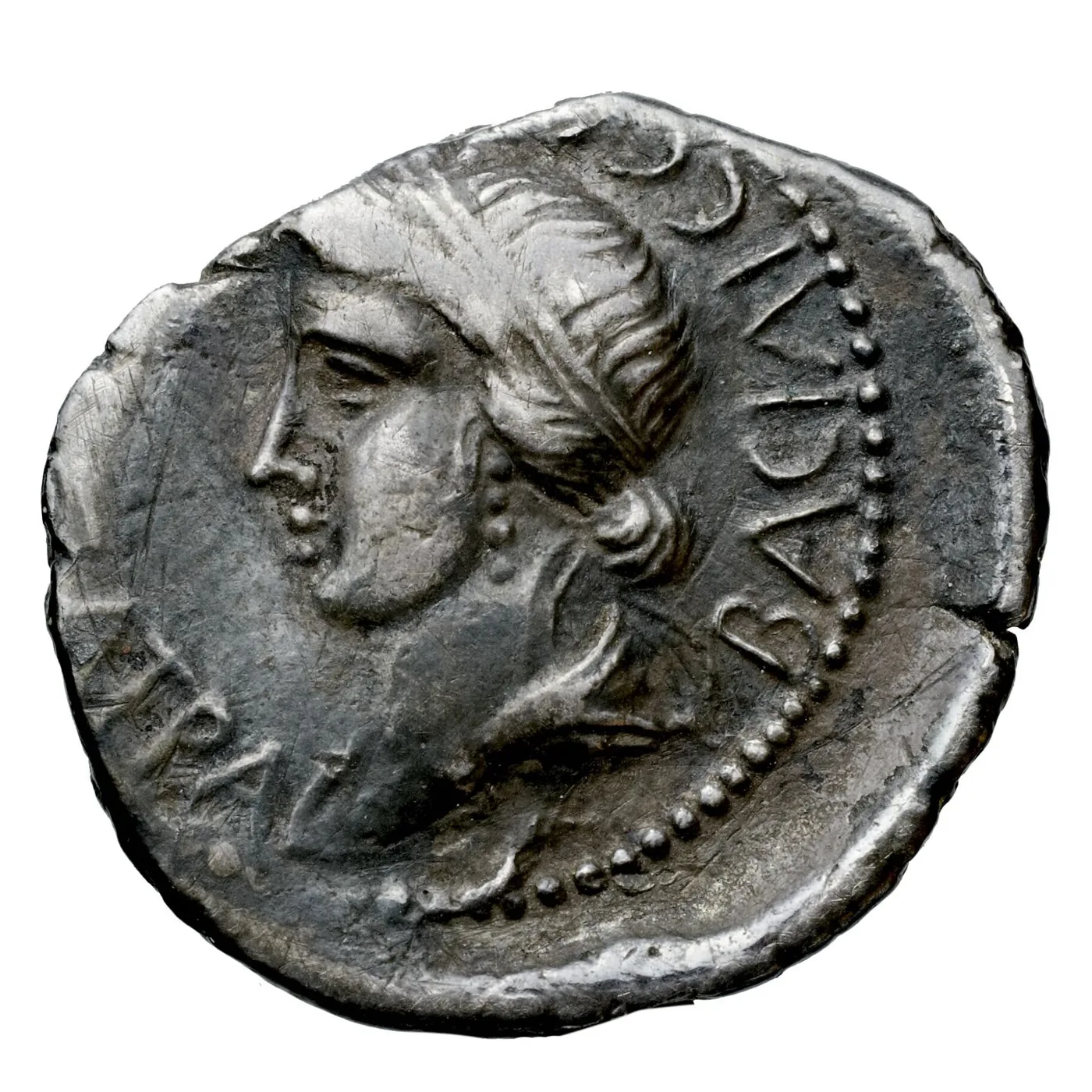
The king set his capital at Iol, on the coast of present-day Algeria, and renamed it Caesarea in honor of his protector. Pliny calls it “Caesarea, formerly named Iol, the royal seat of Juba.” On the kingdom’s silver denarii the queen’s name appears in Greek letters, ΒΑΣΙΛΙΣΣΑ ΚΛΕΟΠΑΤΡΑ, “Queen Cleopatra.” Plutarch, who records the marriage, calls Juba “the most accomplished of kings.”
The west of the kingdom corresponds to today’s Morocco, where Pliny knows, among others, Tingi, Lixus, Banasa, Sala and “the town of Volubilis,” at equal distance from the two seas. It was at Volubilis that the bronze bust now kept in Rabat was found, the best-known face of the king on Moroccan soil.
The king wrote in Greek. His treatise On Libya, in at least three books and composed around 6 CE, is known through Pliny and Athenaeus. In the 2nd century Pausanias will still see his likeness in the gymnasium of Ptolemy at Athens, beside that of the philosopher Chrysippus.
Canaria, the island of the great dogs
Juba’s report
The second name is that of one of the Fortunate Isles, to which Pliny moves on at once. He first cites a certain Statius Sebosus, before opening his best-known paragraph with these words: Iuba de Fortunatis ita inquisivit, “this is what Juba established about the Fortunate Isles.”
The king most likely did not sail to the islands himself. However, Alicia Garcia, of the University of La Laguna, speaks of an expedition “of a political and scientific nature” sent to the Canaries, whose results the king recorded in his treatise On Libya. Mederos and Escribano date it to around 19 to 10 BCE, with the consent of Augustus, after a reconnaissance of the Draa valley where the king hoped to find the sources of the Nile. As Pliny measures the distance to the Fortunate Isles “from the Purpurariae,” 625 miles, the expedition therefore set out from Mogador, from the very islets where the king dyed his purple.
Six islands
The first is called Ombrios, with no trace of buildings, a pond in the mountains and trees like the giant fennel from which water is pressed. Next comes Junonia, which has only a small stone shrine, another smaller Junonia, and Capraria, “full of great lizards.” In sight of these rises Ninguaria, “which took its name from its perpetual snow,” always under cloud. Canarian scholars recognize the Teide and Tenerife in it.

Proximam ei Canariam vocari a multitudine canum ingentis magnitudinis, ex quibus perducti sunt Iubae duo; apparere ibi vestigia aedificiorum.
“The nearest to it is called Canaria, from the multitude of dogs of very great size, two of which were brought to Juba; traces of buildings are seen there.”
— Pliny the Elder, Natural History, VI, 205 (our translation)
All of them abound in fruit and in birds of every kind, the report adds, and Canaria has date palms, pine nuts, honey, papyrus and catfish in its rivers. The shores are infested with sea monsters that the sea casts up and that rot where they lie.
Canaria will become Gran Canaria, before giving its name to all seven islands of the archipelago. Garcia recalls that Pliny is “the only source” for this text. It was thus from a Moorish king that the first text in the history of the Canaries came. Two of those great dogs will be led to Caesarea. Mederos and Escribano note that archaeology has found few traces of them, three skulls in the Guayadeque ravine, and that those two dogs remain the best proof that Juba’s men did land.
Did the dogs give the island its name? Jehan Desanges, cited by Garcia, holds Pliny’s explanation to be a false etymology. Indeed, Pliny also knows of the Canarii, a people of the forests of the Moroccan Atlas, met by the consul Suetonius Paulinus in 42 CE, who “share their food with that animal and the entrails of wild beasts.”
Whether the name came from the dogs of the island or from a tribe of the Atlas, it was born on Juba’s coast.
The euphorbia of Mount Atlas
The king’s physician
The third name is that of a plant that carries a man’s name, and whose birth Pliny tells of in Book XXV:
Invenit et patrum nostrorum aetate rex Iuba quam appellavit Euphorbeam medici sui nomine. Frater is fuit Musae, a quo divum Augustum conservatum indicavimus.
“In the time of our fathers King Juba also discovered the plant he named euphorbea, after his physician. This man was the brother of Musa, who saved the deified Augustus, as we have said.”
— Pliny the Elder, Natural History, XXV, 77 (our translation)
Euphorbus, then, was the brother of Antonius Musa, the physician who treated Augustus. Pliny adds that the two brothers introduced cold baths to Rome, where people had washed only in hot water, “as in Homer.” Thus the court of Caesarea and the palace of Augustus were treated by the same family.

The king wrote a whole book on his plant, which Pliny still had before his eyes: “Juba’s volume on this herb also survives, and it is a brilliant eulogy.”
He had found it “on Mount Atlas,” shaped like a thyrsus, with acanthus leaves. Its sap is so violent that it is cut from a distance with a pole and caught in the stomachs of young goats. The juice flows like milk and dries into grains that look like frankincense. In Book V, Pliny specifies that Juba praised this milk “for clearness of sight and against serpents and every poison.” He also notes that the Gaetulians who gather it, “out of weariness, adulterate it with milk.” The counterfeiters of the Atlas are two thousand years old.
From Juba to Linnaeus
The name will outlive the plant, as Linnaeus will take up Euphorbia in 1753 for a whole genus in his Species Plantarum, a name that botanists the world over still use. As for Juba’s plant, botanists have a candidate, Euphorbia resinifera, described in 1863 from Moroccan specimens, whose dried gum was sold in pharmacies under the name euphorbium. The identification remains a hypothesis, however, since Pliny’s text does not allow a decision.

The Canaries, in their turn, will give his name to a plant. Between 1836 and 1850, Philip Barker Webb and Sabin Berthelot described in their Phytographia Canariensis a shrubby spurge from Tenerife and named it Euphorbia regis-jubae, King Juba’s euphorbia. In 1932 Rene Maire will enter it, as a subspecies, in the Catalogue des plantes du Maroc. The plant that bears the king’s name grows on the islands he named, and on his own coast.

A king in the museums
“Juba died lately,” Strabo wrote, “but his son Ptolemy, whose mother was the daughter of Antony and Cleopatra, has succeeded to the throne.” His death is placed around 23 CE, after nearly half a century of rule.
Ptolemy’s fate under Caligula deserves an article of its own, and we will return to it.
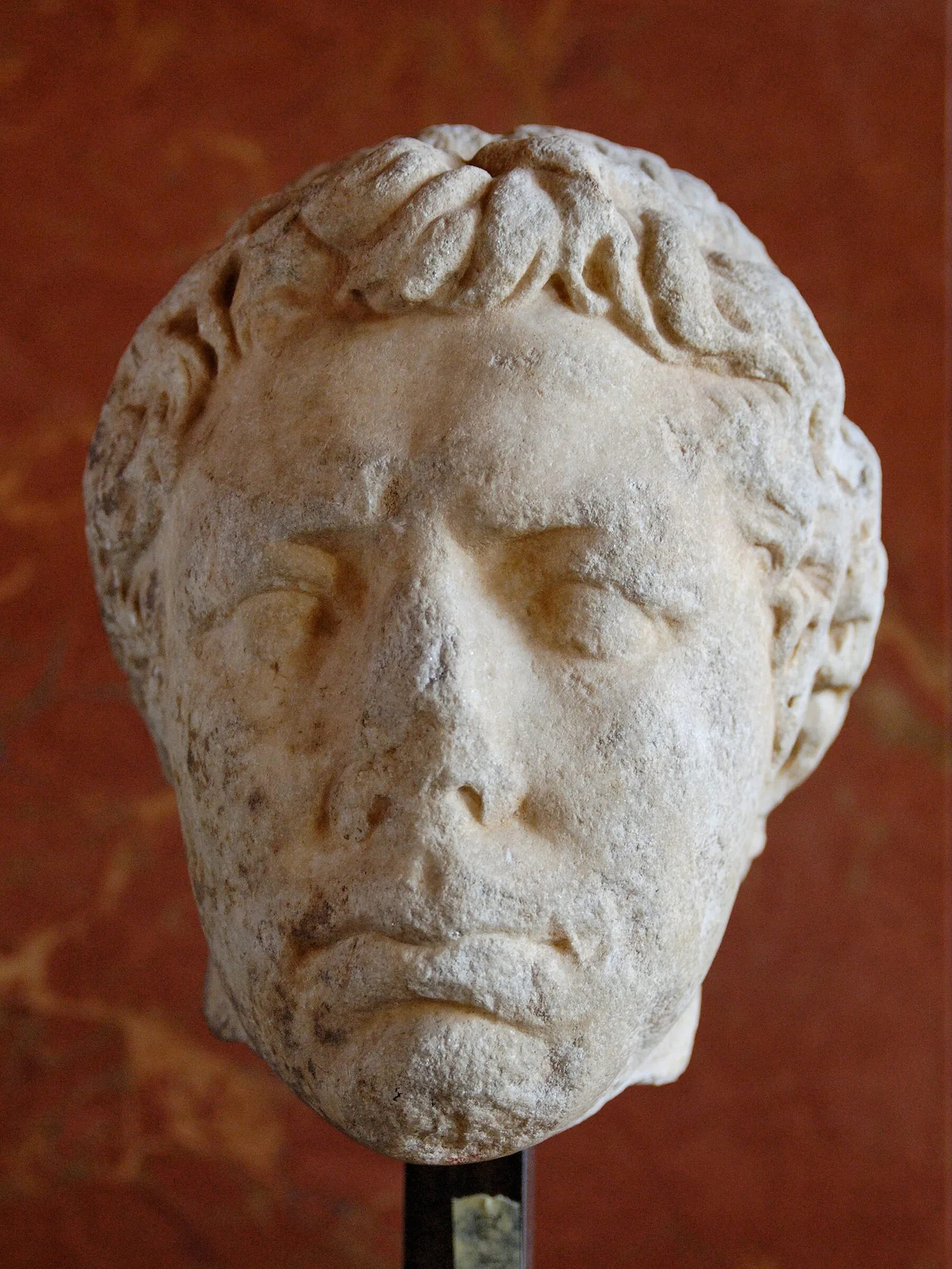
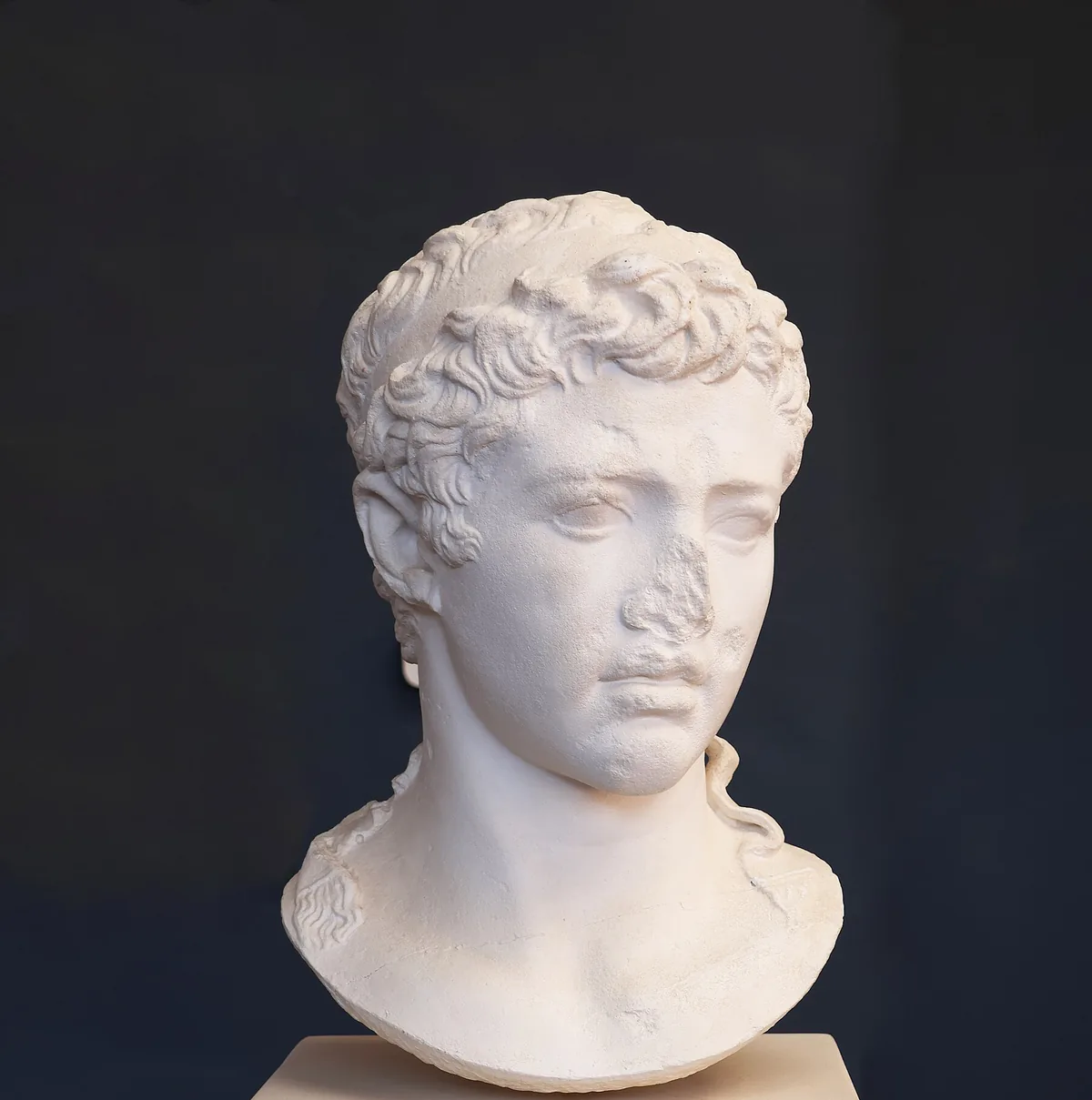
Pliny was right to prefer the scholar to the sovereign, since a generation later Caesarea will be no more than a Roman colony of the emperor Claudius, as Pliny himself notes. The king is in the museums today. His marble head is in the Louvre and in the Glyptotek of Copenhagen, his portrait and that of Cleopatra Selene in the museum of Cherchell, the former Caesarea. In Morocco, the bronze from Volubilis is kept in Rabat, and the islets of Mogador hold his shells. It is time to give this king, in our country too, the place that Plutarch and Pliny gave him.
- Pliny the Elder, Naturalis Historia, V, 5 and 14-20 (Autololes, Volubilis, the Canarii of the Atlas and the expedition of Suetonius Paulinus, the judgment on Juba and the euphorbia of the Atlas, Caesarea); VI, 199-205 (Gorgades, Purple Islands, Fortunate Isles); XXV, 77-79 (euphorbea). Latin text of the Mayhoff edition (Teubner), read on The Latin Library and Wikisource; translations by the editors.
- Plutarch, Life of Caesar, 55, 2-3 (the infant Juba in the triumph of 46) and Life of Antony, 87, 1 (the marriage to Cleopatra Selene), Loeb edition, LacusCurtius.
- Cassius Dio, Roman History, LI, 15, 6 (Juba raised in Italy, the maid and the kingdom of his fathers) and LIII, 26, 2 (the exchange of 25 BCE), Loeb edition, LacusCurtius.
- Strabo, Geography, XVII, 3, 7, 9 and 12 (the succession of Ptolemy, Iol renamed Caesarea), Loeb edition, LacusCurtius.
- Pausanias, Description of Greece, I, 17, 2 (“Juba the Libyan” in the gymnasium of Ptolemy), Jones translation, Loeb, 1918.
- Alicia Mª García García, « El informe de Juba II sobre las Fortunatae Insulae (Plinio el Viejo, HN, VI, 202-205) », Tabona, 17, 2008, pp. 141-164 (Dialnet, Universidad de La Laguna).
- Alfredo Mederos Martín and Gabriel Escribano Cobo, « Las Islas Afortunadas de Juba II. Púnico-gaditanos y romano-mauretanos en Canarias », Gerión, 20, 1, 2002, pp. 315-358 (Universidad Complutense de Madrid). Dating of the expedition, identification of the islands, coins of Juba and Cleopatra Selene at Mogador after Thouvenot 1954, Desjacques and Koeberlé 1955 and Jodin 1967, dog skulls of Guayadeque after Zeuner 1958-59.
- André Jodin, « Les rois maures et les Îles Purpuraires (Mogador) », Ktèma, 21, 1996, pp. 203-211 (Persée), and Les établissements du roi Juba II aux îles Purpuraires (Mogador), Tangier, 1967. Vidal de La Blache’s identification, Mélanges Perrot, 1902, pp. 325-329, is recalled there.
- International Plant Names Index (IPNI), Royal Botanic Gardens, Kew: Euphorbia L., Species Plantarum, 1: 450, 1753; Euphorbia resinifera O.Berg, Darstellung und Beschreibung sämmtlicher in der Pharmacopoea borussica aufgeführten officinellen Gewächse, 1863, “Marocc.”; Euphorbia regis-jubae Webb & Berthel., Histoire naturelle des Îles Canaries, Phytographia Canariensis, III, p. 250, “Ins. Teneriff.”; Euphorbia obtusifolia subsp. regis-jubae (Webb & Berthel.) Maire, Catalogue des plantes du Maroc, 2: 462, 1932.
- Franz Eugen Köhler, Köhler’s Medizinal-Pflanzen, 1887, plate 59, “Euphorbium” (Euphorbia resinifera).